Table of content
- What Is a Topical Map?
- Why Topical Maps Matter for SEO in 2026
- How Search Engines Use Topical Relationships
- Benefits of Using Topical Maps
- How to Create a Topical Map for SEO
- Topical Maps vs Traditional Keyword SEO
- Common Topical Map Mistakes to Avoid
- How RankyFy Helps You Build Smarter Topical Maps
- Why Topical Maps Are Essential for AI Search
- Last Thoughts
In 2026, SEO is not just limited to keywords. Search engines now emphasize websites that offer a deep expertise and strong topical relevance across an entire subject.
This drastic shift has introduced one of the most important concepts of SEO - Topical maps.
A topical map helps you organize your content strategically around cluster topics or entities. This approach helps portray your expertise and build trust among users.
Here, we will explain what topical maps are, their significance, and how to leverage them for long-term organic growth.
Get Stronger Topical Authority for Your Business with RankyFy Tool
What Is a Topical Map?
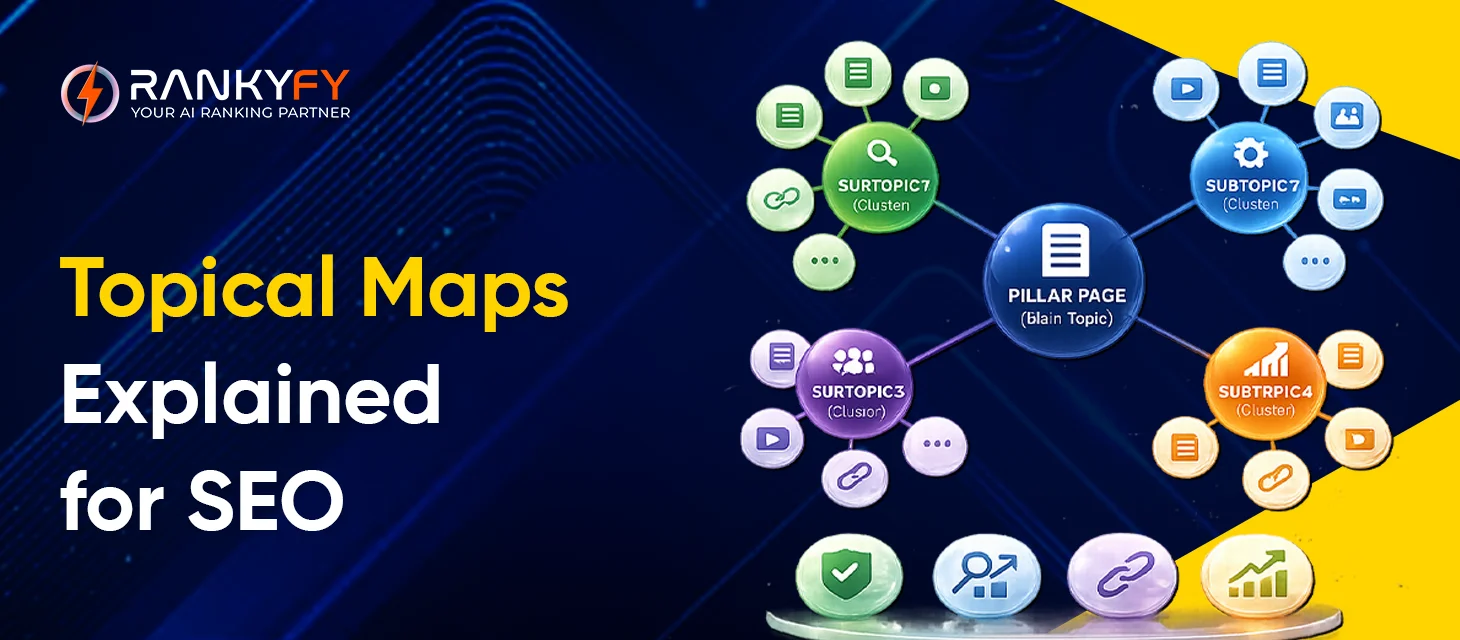
A topical map is a structured SEO content plan that organizes all topics and subtopics around a main subject to build strong topical authority for a website.
It helps search engines understand:
-
What your website is about
-
How different pieces of content relate to each other
The depth of your expertise within a niche
Instead of focusing on individual keywords alone, topical maps focus on comprehensive topic coverage.
Example of a Topical Map
Let’s say your primary topic is SEO.
A topical map for SEO could include:
-
Keyword research
-
Technical SEO
-
Link building
-
Semantic SEO
-
Local SEO
-
AI SEO
-
On-page SEO
-
SEO analytics
-
Topical authority
Each subtopic can then branch into more detailed supporting articles. This helps your website create a strong and reliable content authority.
Why Topical Maps Matter for SEO in 2026
Today, both traditional and AI-driven search engines evaluate your website contextually.
Topical maps help improve:
-
Topical authority
-
Semantic relevance
-
Internal linking structure
-
Search intent coverage
-
AI search visibility
-
Content organization
How Search Engines Use Topical Relationships
Modern search engines understand relationships between:
-
Entities
-
Concepts
-
User intent
-
Semantic meaning
-
Content hierarchy
For example, a website covering “SEO” comprehensively with related subtopics appears more authoritative than a site with only a few isolated SEO articles.
This is why topical mapping has become critical for long-term SEO growth.
Benefits of Using Topical Maps
-
Stronger Topical Authority
Topical maps help establish expertise within a niche by covering related subjects comprehensively.
-
Better Internal Linking
A topical structure naturally improves internal linking opportunities.
This helps:
-
Search engine crawling
-
User navigation
-
Content discoverability
-
Improved Search Visibility
Covering multiple related topics increases opportunities to rank for broader keyword variations.
-
Better AI Search Optimization
AI-powered search systems prefer websites with structured and context-rich content ecosystems.
-
More Organized Content Strategy
Topical maps eliminate random publishing and create a clear content roadmap.
How to Create a Topical Map for SEO
-
Choose a Core Topic
Start by choosing a subject and building authority around it.
Examples:
-
SEO
-
Fitness
-
Cybersecurity
-
Identify Major Subtopics
Break the core topic into broader supporting categories.
Here are some examples:
-
Content SEO
-
Link building
-
Local SEO
These become your content pillars.
-
Expand into Supporting Topics
Each major category should include smaller supporting topics.
Example:
-
Crawlability
-
Indexing
-
Site speed
-
Core Web Vitals
-
Mobile optimization
This creates depth and semantic coverage.
-
Analyze Search Intent
Every topic should align with user intent.
Understand whether users want:
-
Educational content
-
Tutorials
-
Comparisons
-
Product recommendations
-
Case studies
Intent alignment improves SEO performance significantly.
-
Build Internal Linking Connections
Topical maps work best when content pieces are interconnected logically.
Link:
-
Pillar pages to supporting content
-
Supporting articles back to pillar pages
-
Related subtopics together
This strengthens semantic relationships.
-
Include Semantic SEO Elements
Modern search engines understand contextual meaning.
Include:
-
Related entities
-
Synonyms
-
Industry terminology
-
Contextual phrases
Semantic SEO improves topical depth and AI comprehension.
-
Update the Map Regularly
SEO evolves constantly.
Expand and refine your topical map over time by adding:
-
New subtopics
-
Updated search intent opportunities
Topical Maps vs Traditional Keyword SEO
| Traditional SEO | Topical Map SEO |
|---|---|
| Focuses on single keywords | Focuses on topic ecosystems |
| Isolated articles | Interconnected content |
| Limited semantic relevance | Strong contextual relevance |
| Short-term ranking focus | Long-term authority focus |
| Keyword-heavy optimization | Search intent + semantic SEO |
Common Topical Map Mistakes to Avoid
Publishing Random Content
Unrelated articles weaken topical relevance.
Weak Internal Linking
Disconnected content reduces semantic relationships.
Ignoring Search Intent
Even strong topic coverage can fail if the intent is mismatched.
Thin Content
Surface-level articles rarely build authority.
How RankyFy Helps You Build Smarter Topical Maps

Creating effective topical maps manually can become overwhelming, especially in competitive niches.
This is where RankyFy helps.
RankyFy helps businesses create structured SEO strategies. It focuses on semantic relevance, topical authority, and AI search optimization.
Here’s how RankyFy helps:
-
Semantic Topic Discovery
Identify related topics, entities, and contextual opportunities automatically.
-
Topic Cluster Planning
Build organized content ecosystems designed for stronger authority.
-
Search Intent Analysis
RankyFy helps you understand the user search intent.
-
Competitor Gap Analysis
The platform helps you discover competitor gaps that you can leverage to rank ahead.
-
AI SEO
RankyFy ensures your content is structured for AI-driven search engine landscapes.
-
Internal Linking Recommendations
The platforms help you strengthen topical relationships. This helps improve crawlability.
Why Topical Maps Are Essential for AI Search
The AI-driven search engines prioritize contextual understanding. With Topical Maps, you can ensure your website offers meaningful content for users.
They prioritize websites that demonstrate:
-
Expertise
-
Topic depth
-
Structured content relationships
-
Semantic clarity
Get Stronger Topical Authority for Your Business with RankyFy Tool
Last Thoughts
In 2026. Topical maps are one of the most important SEO strategies. This strategy emphasizes offering expertise across an entire subject area instead of just keywords.
Building content around a specific niche and strengthening internal linking can improve the overall search performance of businesses.
Along with platforms like RankyFy, businesses can create strong topical map strategies and build a sustainable online presence. The platform also helps businesses stay equipped for the future of the AI-driven search landscape. Try RankyFy today!
What to read next

Programmatic SEO Explained
Programmatic SEO (pSEO) is the process of automatically scaling content creation to generate hundreds or...
Read More
GEO vs SEO: What’s the Difference?
In 2026, the search optimization landscape is changing rapidly. Earlier, businesses used to emphasize traditional...
Read More
Best SEO Prompts for ChatGPT
ChatGPT is among the most powerful AI tools for SEO in 2026. This tool can...
Read More
How to Find Buyer Intent Keywords
In 2026, driving traffic to your website is important. However, traffic alone does not guarantee...
Read More