Table of content
- How Does Local SEO Work?
- The Three Pillars of Google’s Local Algorithm
- Why Does Local SEO Matter So Much?
- Local SEO Vs.Traditional SEO: What’s the Difference?
- Core Tasks in Local SEO
- 5. Get More Reviews and Manage Them
- 6. Optimize Your Website for Local Search
- Use Geo-Targeted Keywords
- Create Strong Location Pages
- Publish Localized Content
- Beyond the Basics: Other Local SEO Tasks
- Tracking Your Local SEO Performance
- How RankyFy Makes Local SEO Easier
- What’s Next?
Local search engine optimization (local SEO) is one of the most important parts of increasing visibility in local areas. The result is finding in “near me” searches or queries that include a city, neighborhood, or area.
When someone types “best pizza place in Manhattan” into Google, they don’t want a blog post about pizza. They want an actual pizza place they can visit or call. Google responds with a special set of results called the Local Pack, powered by a local search algorithm that looks at real businesses and their Google Business Profiles (GBP).
Local SEO is the work you do to convince the local algorithm that your business should appear in those results, ahead of nearby competitors. It’s not luck. It’s a deliberate optimization process.
 Start with the fundamentals if you're new to local SEO. Nearly all local businesses require these foundations:
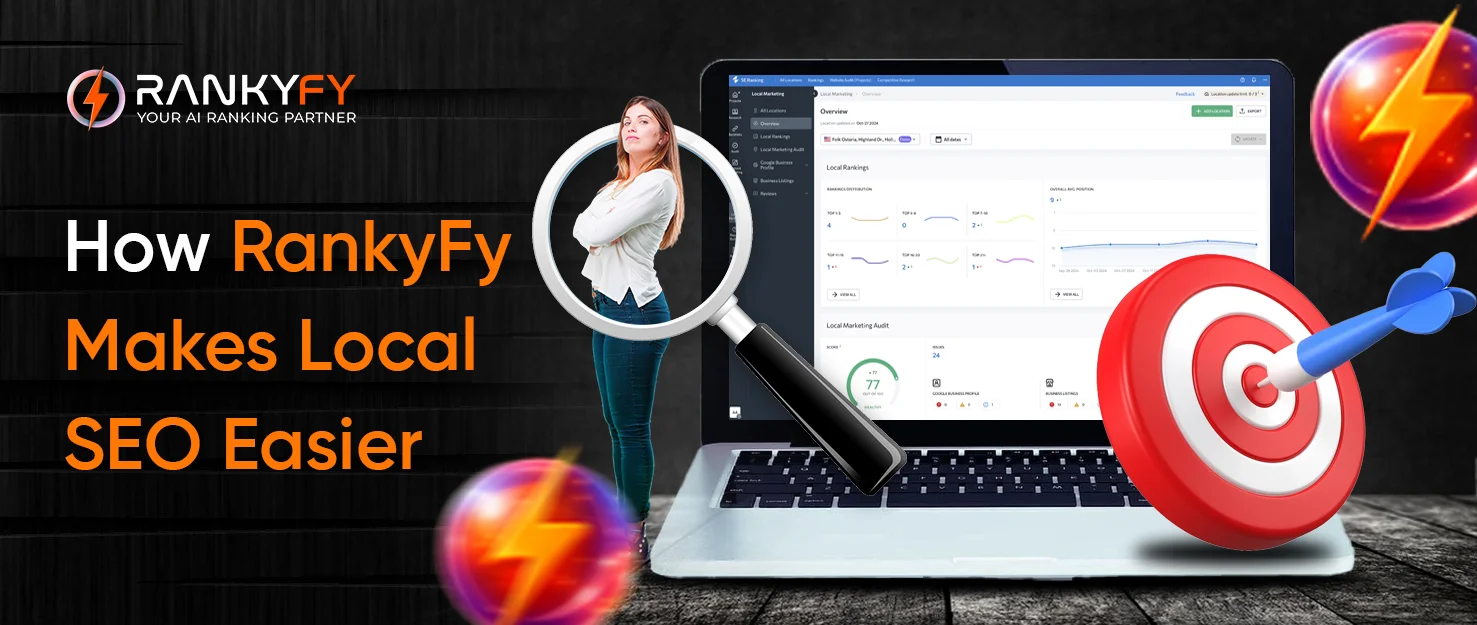 All of this is powerful—but also complex and time‑consuming. That’s where RankyFy, our AI‑powered SEO platform, changes the game for local businesses and agencies.
1. AI-Driven Local Keyword Discovery
2. Smart Google Business Profile Optimization
3. Automated Local Content Generation
4. Competitor and Local SERP Intelligence
5. Citation and NAP Consistency Audits
6. Review Monitoring and Insights
7. Local Rank Tracking and Reporting
All of this is powerful—but also complex and time‑consuming. That’s where RankyFy, our AI‑powered SEO platform, changes the game for local businesses and agencies.
1. AI-Driven Local Keyword Discovery
2. Smart Google Business Profile Optimization
3. Automated Local Content Generation
4. Competitor and Local SERP Intelligence
5. Citation and NAP Consistency Audits
6. Review Monitoring and Insights
7. Local Rank Tracking and Reporting

- A common misconception about local SEO is that it is all about creating a GMB (Google My Business) account
- Adding your city name to a few pages on your site.
How Does Local SEO Work?
From a single-location coffee shop to managing SEO for a multi‑location brand, local SEO comes down to one core question: “How do I show up when nearby customers search for my product/service?” To answer that, you need to understand how Google’s local algorithm works—and then optimize for it.The Three Pillars of Google’s Local Algorithm
Google’s local system evaluates three main pillars to decide which businesses to show: Relevance How closely does your business match what the user is searching for? Google looks at:- Your primary and secondary categories in Google Business Profile
- Your GBP description and attributes
- Local business listings (citations)
- Your website’s content and on-page optimization
- This is what makes local SEO truly “local.” Two otherwise identical businesses can rank very differently depending on where the user is standing.
- Number and quality of reviews
- Overall rating and sentiment
- Links from reputable and relevant websites
- Citations, local PR, and brand references on the internet
Why Does Local SEO Matter So Much?
You are essentially invisible when people conduct local searches if you don't use local SEO. Without local SEO, you’re effectively invisible when people perform local searches. Imagine a user in Chicago searching “nail salon in Lincoln Park.” If your competitors have:- Hundreds of reviews
- Fully optimized and active Google Business Profiles
- Well‑structured, location‑focused landing pages
- Better online visibility in local search results
- Increased foot traffic to your physical location
- Highly targeted website visits from nearby customers
- More calls and inquiries from your Google Business Profile
- Higher trust and credibility through reviews and consistent data
- More local sales and leads
- Improved conversion rates from both organic and GBP traffic
Local SEO Vs.Traditional SEO: What’s the Difference?
The goal of traditional SEO is to rank web pages in non-localized results, such as an e-commerce site ranking for "running shoes."- Ranking actual companies in local search results (such as "running shoe store in Brooklyn") is the main goal of local SEO.
- A crucial detail: if a company has a well-optimized Google Business Profile, it can theoretically rank locally without a website.
- “car tires” → Mostly shopping results, ads, and national websites
- “car tires lincoln park chicago” → A Local Pack with a map and local GBPs, followed by localized organic results
- Link building and digital PR
- Technical SEO and site performance
- Content creation and on‑page optimization
Core Tasks in Local SEO
Start with the fundamentals if you're new to local SEO. Nearly all local businesses require these foundations:
- Claim and optimize your Google Business Profile
- Perform local keyword research
- Analyze local competitors
- Build and maintain local listings (citations)
- Obtain and handle more client reviews
- Make your website more search engine-friendly.
- Make content that is location-specific and localized.
1. Claim and Optimize Your Google Business Profile
Your Google Business Profile is the backbone of local SEO. It’s how Google understands:- What you do
- Where you’re located
- Who you serve
- How customers feel about you
- Select the most accurate primary category, plus relevant secondary categories
- Add and maintain correct NAP (Name, Address, Phone) and opening hours
- Upload high‑quality photos and videos
- Publish regular Google Posts for offers, events, and updates
- Use Q&A to answer common questions
- Actively request and respond to Google reviews
2. Do Local Keyword Research
Local SEO still starts with keywords—but with a geographic layer. Think about how real customers would search for you. Begin with a small, transactional set such as: For a nail salon in Lincoln Park, Chicago:- “nail salon near me”
- “nail salon in Lincoln Park”
- “Lincoln Park manicure”
- “best pedicure Lincoln Park”
- Your GBP business description and Posts
- Your website content and location pages
- Your internal linking strategy
3. Analyze Your Local Competitors
Once you know your target keywords, search them and see who appears:- In the Local Pack
- In the top local organic results
- Do they have more—and better—reviews?
- Is their GBP fully filled out and visually appealing?
- Are they using local landing pages?
- Do they have local press mentions or local backlinks?
4. Build and Maintain Local Listings (Citations)
Local citations are mentions of your business’s Name, Address, and Phone number (NAP) on third‑party sites like directories, maps, and local platforms. They matter because:- Google uses citations to verify your business information
- Consistent data across the web builds trust with both search engines and users
- Getting listed on authoritative, relevant, and often‑used directories in your country and niche
- Ensuring your NAP is 100% consistent across all citations
- Keeping listings updated if your business moves, rebrands, or changes phone numbers
5. Get More Reviews and Manage Them
Reviews sit at the intersection of SEO, reputation management, and customer service. They’re a strong ranking and conversion signal. For local SEO, you should:- Regularly ask happy customers to leave reviews on Google (and other platforms that matter in your industry)
- Respond to all reviews—positive and negative—professionally and promptly
- Watch for patterns in feedback that reveal service or product issues
- Follow each platform’s review guidelines to avoid removals or penalties
6. Optimize Your Website for Local Search
You don’t strictly need a website to appear in local search, but relying only on GBP limits your visibility and authority. A well‑optimized site gives you a major advantage. Start with general on‑page SEO best practices:- Unique, descriptive title tags and meta descriptions
- Clear site structure and internal linking
- Fast, mobile‑friendly pages (use tools like Chrome Lighthouse)
- Local business schema markup where appropriate
- Good overall user experience
Use Geo-Targeted Keywords
Integrate phrases like:- “replacement car tires in Lincoln Park”
- “manicure in Lincoln Park”
- A more general homepage (city/region/state level)
- Dedicated location pages for each branch or area served
Create Strong Location Pages
If you have multiple branches or service areas, each should have its own optimized page targeting “[service] in [location].” Make these pages genuinely useful, not just keyword‑stuffed:- Clear NAP details for that location
- Embedded map
- Local reviews or testimonials
- Location‑specific FAQs
- Mention nearby landmarks, neighborhoods, or hubs
Publish Localized Content
In competitive markets, localized content helps establish topical and geographic authority. Examples:- Law firms: Guides about state‑ or city‑specific laws (“Divorce law in Texas: What’s different and what to expect”).
- Real estate: Neighborhood guides, school overviews, lists of the best local amenities (“Moving to [Area]: A Complete Guide to Schools, Dining, and Transport”).
Beyond the Basics: Other Local SEO Tasks
Once the foundations are in place, you can expand your efforts to include:- Local link building and digital PR from relevant organizations, blogs, chambers of commerce, and local media
- Monitoring Google’s algorithm updates and local SERP changes
- Reporting spam or rule‑breaking competitors that violate Google’s guidelines
- Engaging with your local community (events, sponsorships, collaborations)
- Maintaining active social media profiles that reflect your brand and location
Tracking Your Local SEO Performance
Optimization without measurement is guesswork. Track your efforts so you can double down on what works. Key tools to monitor performance:- Google Business Profile Performance – Views, searches, calls, direction requests, and more
- Google Search Console – Queries, impressions, and clicks for your pages in organic search
- Google Analytics 4 – On‑site behavior, conversions, and traffic from different channels
How RankyFy Makes Local SEO Easier
All of this is powerful—but also complex and time‑consuming. That’s where RankyFy, our AI‑powered SEO platform, changes the game for local businesses and agencies.
1. AI-Driven Local Keyword Discovery
2. Smart Google Business Profile Optimization
3. Automated Local Content Generation
4. Competitor and Local SERP Intelligence
5. Citation and NAP Consistency Audits
6. Review Monitoring and Insights
7. Local Rank Tracking and Reporting
What’s Next?
For location-based enterprises, local SEO is now mandatory rather than discretionary. Every facet of local SEO is manually manageable, but the process is slow, which might delay results. AI-driven research, optimization, content, competitive intelligence, and tracking—all customized for local search—are all combined in RankyFy. If you’re ready to:- Appear more often in the Local Pack
- Attract nearby customers at the exact moment they’re ready to buy
- Scale local SEO efficiently across locations or clients
What to read next

13 Proven Ways To Use the Meta Ad Library for Research
Meta Ads Library is a free research tool for marketers. The platform is known for...
Read More
Search Terms: Meaning & How to Use Them
Understanding search phrases is important to reach potential customers in a conversational tone. Search terms...
Read More
How to Migrate a Website Without Harming SEO (Complete Checklist)
How to Migrate a Website Without Harming SEO - Migrating a live website is a...
Read More
On-Page SEO Explained: A Complete Guide
What prevents your website from showing up at the top of search engine results? You...
Read More