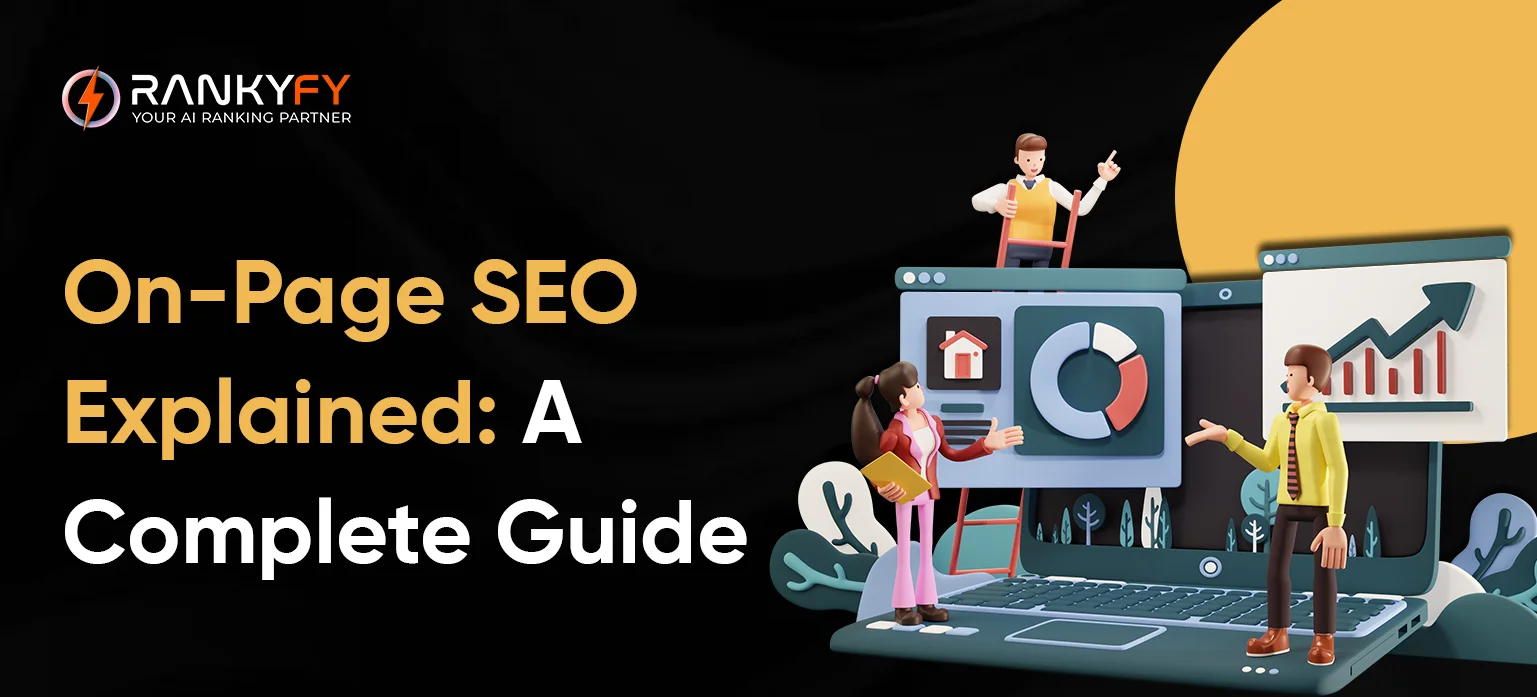
What prevents your website from showing up at the top of search engine results? You are most likely making a mistake. Checking the on-page components is preferable. The search engines must detect a significant hole in the backend. It could be a content gap, a broken link, or something else.
In this post, we'll go into great detail about on-page SEO, which will enhance your website and raise your ranking.
What is On-Page SEO?
"On-page SEO" describes modifications applied to a particular webpage. Increasing visibility for keywords is the aim. Some of the tasks performed include internal linking, URL architecture, meta titles, meta descriptions, and schema markup. In addition to this, the on-page content includes graphics and user-friendly elements. High-intent visits and a higher ranking are the two main elements to consider for on-page. It elevates user experience and leads to generation. Here's an example for better understanding: Strong on-page SEO for a blog post on "Best AI tool" would include using the main keyword in the title and H1, organizing the content with distinct subheadings, optimizing images with informative alt text, adding internal links to relevant casino guides, and crafting an engaging meta description. When combined, these components make the page more user-friendly and easier for search engines to comprehend, which improves ranks and increases conversions.On-page SEO vs off-page and technical SEO
To help with understanding, a comparison of on-page and off-page SEO is provided below.| Aspect | On-Page SEO | Off-Page SEO |
|---|---|---|
| Definition | Optimizations made directly on your website pages to improve rankings and relevance | Actions taken outside your website to build authority, trust, and credibility |
| Primary Focus | Content quality, page structure, and technical clarity | Brand authority, backlinks, and external signals |
| Key Factors | Content optimization, keyword usage, meta tags, headings, internal links, URL structure, image optimization, schema markup | Backlink building, brand mentions, social signals, influencer outreach, guest posting, PR |
| Control Level | Fully controllable by the website owner | Partially controllable; depends on third-party platforms |
| User Experience Impact | Directly improves usability, readability, and engagement | Indirect impact through trust and brand recognition |
| SEO Objective | Help search engines understand page relevance and intent | Signal popularity and authority to search engines |
| Time to See Results | Faster impact once changes are implemented | Slower, cumulative impact over time |
| Examples | Optimizing a blog’s H1, improving page speed, adding internal links, and writing SEO-friendly meta descriptions | Earning backlinks from authoritative websites, digital PR campaigns, and citations |
| Risk Factor | Low risk when following best practices | Higher risk if using spammy or manipulative link-building tactics |
| Long-Term Value | Foundation of SEO; essential for rankings | Strengthens domain authority and competitive positioning |
The complete On-Page SEO Steps
On-page SEO is the core process of SEO that plays a vital role. However, the processes keep changing with changes in technology. Nowadays, we make use of AI tools to perform on-page tasks. Here’s how we start with the on-page SEO for a website.Do Smart Keyword Research
You can’t optimize a page without knowing what it should rank for. Choose one primary keyword or theme per page. For example, you might target “on-page SEO,” with related keywords like “on-page SEO checklist” and “what is on-page SEO.” To start with :- Use keyword tools.
- Check search volume
- Select low to medium competition
- Terms relevant to your product or audience
- Check search intent.
- Google the keyword and look at the first page:
- Are the top results blogs, product pages, or comparison guides?
- Are they beginner-level, advanced, or transactional?
- Create content as per the requirement
Create Optimized Content
Keyword insertion will not help your content rank for long if it does not have relevance. Search engines repeatedly reward pages that are helpful, accurate, and satisfying to searchers.Aim for content that is:- Trustworthy.
- Facts are correct, claims are backed up, and you deliver what your title promises.
- Useful and complete.
- Answer the question behind the query.
- Actionable.
- Readable.
- The right length.
- Simple topics: 800–1,200 words
- In-depth guides and competitive topics: 1,500–2,500+ words
- Focus on covering the topic properly rather than hitting a number.
- If a sentence doesn’t add clarity, detail, or value, remove it.
Place Keywords Strategically
When you reate a focused content, then the keywords appear naturally in the content. But a good practice is to include the keywords at the right places, that is :- Page title (H1).
- SEO title (title tag).
- First 100–150 words.
- At least one or two H2 subheadings.
- Meta description.
- Image alt text (for at least one relevant image).
- Image file names.
- URL.
Optimize your images
Images improve user experience, keep people on your page longer, and can also rank in Google Images. They can help or hurt your SEO depending on how you handle them.- Use this mini-checklist:
- Compress images for speed.
- Resize to your content width.
- Alt text:
- Gives search engines context.
- Use meaningful file names.
- Use images that add value.
Write Click-Worthy Titles
Every page has two titles: Title tag (SEO title) The title that appears in search results and browser tabs. Aim for: Around 50–60 characters (so it doesn’t get cut off). Your primary keyword is as close to the beginning as natural. Example: “On-Page SEO Explained: 11-Step Checklist for Higher Rankings” H1 heading The main heading on the page. This can be similar or slightly more descriptive and brand-flavored, but it should still contain your main keyword. A strong title should:- Make it clear what the page is about.
- Promise a concrete benefit (save time, get more traffic, avoid mistakes).
- Avoid clickbait or overpromising. If you call something “ultimate” or “complete,” make sure it is.
Use Headings to Structure Pages
Headings are not just for design. They tell readers (and search engines) how your content is organized. Basic best practices include:- One H1 per page.
- Use H2s for main sections.
- Use H3s for subsections under each H2.
- Keep headings descriptive.
Craft Compelling Meta Descriptions
A meta description is the short snippet that appears under your title in search results. It doesn’t directly boost rankings, but it can increase your click-through rate, which is very valuable.- Use this simple formula: of using around 155–160 characters.
- Include your main keyword naturally.
- Tell the reader what they’ll learn or gain.
- Use action-oriented and benefit-oriented language.
Create Clean, SEO-friendly URLs
Your URL is another signal of what the page is about. It should be short, readable, and aligned with your main keyword. Best practices:- Include your primary keyword.
- Use hyphens between words (not underscores or spaces).
- Avoid unnecessary words.
Use Internal and External Links
Links help search engines understand context and spread authority. They also help users discover more relevant content on your site. Internal links include:- Link to other relevant pages on your site.
- Make sure other pages also link to the page you’re optimizing.
- Use descriptive anchor text:
- Good: “learn how to do keyword research.”
- External links:
Fix a Few Key Technical Items
You don’t need to be a developer to check a few important technical boxes that affect the performance of your page.- Mobile-friendliness
- Indexing and crawlability
- Page speed
- Compressed images
- Enable caching via your host or a plugin
- Social share setup
Keep Content Fresh
SEO is not “set and forget.” Even evergreen content needs occasional refreshing, especially in fast-moving industries. Every few months (or at least once a year) for key pages:- Update information and stats.
- Replace outdated references, screenshots, and examples.
- Add new sections or FAQs.
- Answer newly common questions you’re seeing in Search Console or customer queries.
- Fix broken links.
- Update or remove links that no longer work.
- Re-evaluate keyword intent.
- Small, regular updates can help preserve rankings and keep your content competitive.
- Helpful on-page SEO tools
How Quickly RankyFy Helps You Conduct On-Page SEO
RankyFy is an AI tool designed to help with on-page SEO by conducting an on-page audit. With AI-powered recommendations, you can not only fix issues but also further plan the strategy to rank higher. Some of the On-page tasks RankyFy supports include:- Site audits for on-page issues.
- Content & metadata optimization
- Keyword tracking & intent alignment
- Technical signals that affect on-page SEO
How this translates into on-page SEO results
- You get a prioritized list of on-page fixes (titles, headings, content gaps, internal links, speed issues) per URL instead of guessing what to improve.
- AI recommendations help you optimize pages for both Google and AI-driven channels (like ChatGPT and Gemini), so your on-page work has a wider impact.
- Continuous rank tracking and audits make it easier to measure how each on-page change affects visibility and traffic over time.
Conclusion
On-page SEO is the lifeblood of keeping your website crisp, searchable, and extremely profitable, page after page. It's not some one-time patch that you can forget about. If you consistently master the fundamentals by using the AI tools smartly, you will be able to create a visible online presence for your brand. Grab a tool like RankyFy, map out your game plan, and watch your site start pulling its weight—higher ranks, more traffic, real results. What's stopping you? What to read next

13 Proven Ways To Use the Meta Ad Library for Research
Meta Ads Library is a free research tool for marketers. The platform is known for...
Read More
Search Terms: Meaning & How to Use Them
Understanding search phrases is important to reach potential customers in a conversational tone. Search terms...
Read More
How to Migrate a Website Without Harming SEO (Complete Checklist)
How to Migrate a Website Without Harming SEO - Migrating a live website is a...
Read More
How Local SEO Works: Everything You Need to Know
Local search engine optimization (local SEO) is one of the most important parts of increasing...
Read More