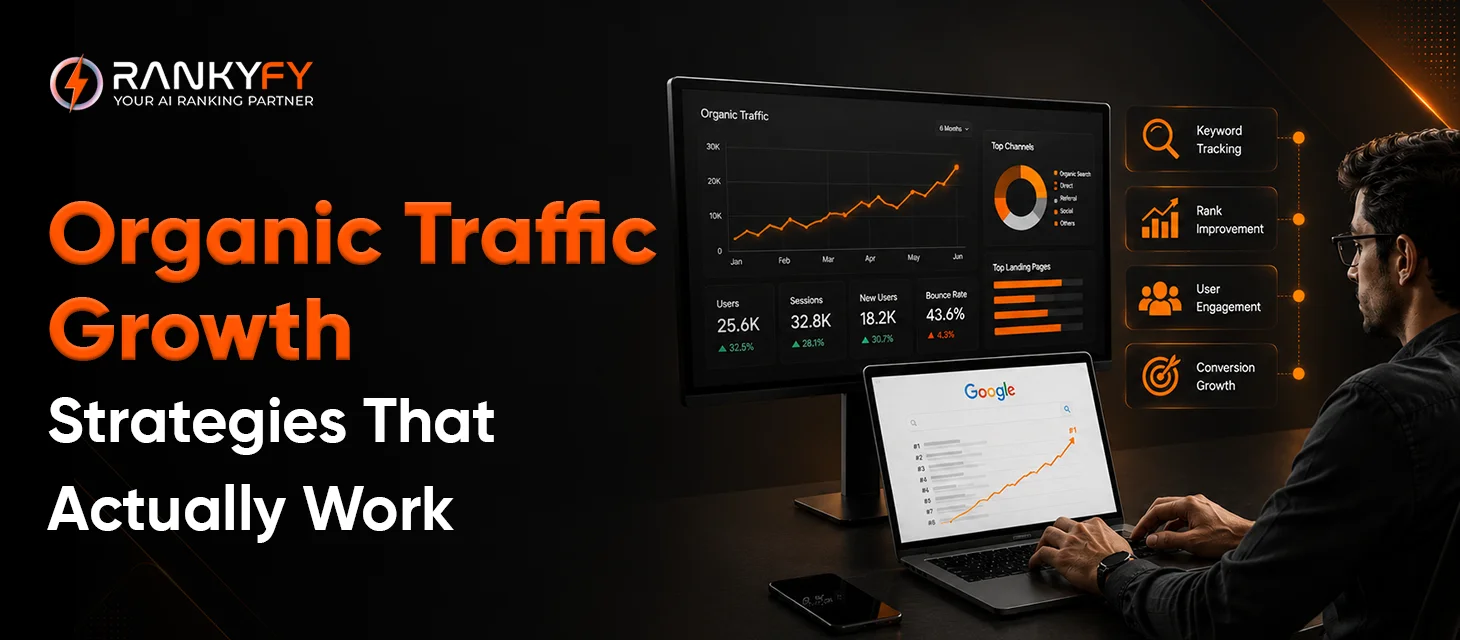
To successfully scale your organic search traffic, you must avoid outdated, high-volume keyword stuffing and instead align your technical foundation with Google's E-E-A-T guidelines, deep semantic search intent, and platform-agnostic distribution.
This post shares proven, real-world organic growth tactics to help you outrank competitors, increase visibility, and attract high-intent visitors without spending a single dollar on ad networks.
Grow your organic traffic with RankyFy
Why Organic Traffic Matters
With organic traffic comes long-term growth benefits. Since the organic visitors are actively looking for solutions, they are more engaging and likely to convert.
What are the advantages of organic traffic?
-
Higher-quality website visitors
-
Lower customer acquisition costs
-
Greater brand credibility
-
Long-term growth
-
Better conversion opportunities
-
Improved visibility across search engines
Top Organic Traffic Growth Strategies
Strategy #1: Focus on Search Intent Instead of Just Keywords
One of the biggest SEO mistakes is targeting keywords without understanding the user search intent.
Google prefers website pages that align with the user search intent. A content piece that satisfies the user search intent is most likely to rank ahead and keep visitors engaged.
To improve organic visibility:
-
Solve users’ queries
-
Align content with the searcher’s goal
-
Include FAQs
-
Cover topics in depth
Strategy #2: Build Topical Authority
Instead of publishing isolated articles, build a cluster of topics. In the long term, this demonstrates your expertise and strengthens your website authority.
Let’s understand this with an example.
Imagine your primary topic is
Technical SEO
Your supporting articles could include:
-
Website audits
-
Crawl errors
-
XML sitemaps
-
Core Web Vitals
-
Internal linking
-
Structured data
Strategy #3: Publish High-Quality Content
Building and posting high-quality content continues to attract traffic long after it's published. This is because it remains relevant over time. It's important to keep them updated and accurate.
Here are some examples:
-
How-to guides
-
Tutorials
-
Industry best practices
-
Comprehensive checklists
-
Beginner guides
Strategy #4: Optimize Every Page for On-Page SEO
Strong on-page SEO is essential to help search engines understand your content better. This also improves the user experience.
Review the following:
-
Unique title tags
-
Compelling meta descriptions
-
Clear heading hierarchy
-
Optimised images
-
Descriptive URLs
-
Relevant internal links
Strategy #5: Strengthen Your Internal Linking Strategy
With internal links, search engines can crawl through your website. It also guides users to other related content on your website.
What are the benefits?
-
Better crawlability
-
Improved topical authority
-
Increased page views
-
Longer session duration
-
Better distribution of page authority
Strategy #6: Improve Your Technical SEO
Even with the best content, your website can struggle to rank if it has technical issues. Search engines need to crawl and index your website to understand it better.
What to review on your website?
-
Broken internal links
-
Crawl and indexing errors
-
Duplicate content
-
Missing XML sitemaps
-
Slow page speed
-
Core Web Vitals issues
-
Mobile usability problems
Grow your organic traffic with RankyFy
Strategy #7: Refresh Existing Content Regularly
Publishing new content is important, but updating the previous pages can deliver faster wins.
Google always prefers content that remains correct and relevant.
When refreshing older articles:
-
Update outdated statistics.
-
Add new sections.
-
Improve readability.
-
Include recent examples.
-
Expand answers to common questions.
-
Optimize headings and metadata.
Updating the previous content helps maintain your search rankings while improving CTRs.
Strategy #8: Optimize for AI-Powered Search
Today, search behavior has evolved beyond traditional search engines. AI search platforms like Google AI Overviews, Gemini, and ChatGPT have increasingly surfaced.
To improve AI search visibility:
-
Answer questions directly.
-
Use structured headings
-
Offer in-depth information
-
Include related entities and semantic keywords.
-
Write concise definitions beneath important headings.
-
Structure content using logical sections and bullet points.
Design your content for both users and AI searches.
Strategy #9: Earn High-Quality Backlinks
One of the strongest Google ranking signals is backlinks.
With high-quality backlinks, you can strengthen your website’s authority.
What are effective backlink strategies:
-
Publishing original research.
-
Writing guest articles.
-
Creating comprehensive industry guides.
-
Producing shareable resources.
-
Building and nurturing relationships with authoritative publications
Strategy #10: Monitor and Improve SEO Performance
Since SEO is an ongoing process, it requires consistent analysis and optimization.
Here are some key performance indicators:
-
Organic traffic
-
Keyword rankings
-
Click-through rates
-
Bounce rate
-
Indexed pages
-
Conversion rates
-
Core Web Vitals
With regular monitoring, you can identify new opportunities and respond to them quickly.
Organic Traffic Growth Strategies at a Glance
| Strategy | Primary Benefit | SEO Impact |
|---|---|---|
| Match search intent | Better user satisfaction | Higher rankings |
| Build topical authority | Improved expertise | Greater visibility |
| Publish evergreen content | Long-term traffic | Sustainable growth |
| Optimize on-page SEO | Better page relevance | Improved CTR and rankings |
| Strengthen internal linking | Better crawlability | Stronger site authority |
| Improve technical SEO | Healthier website | Faster indexing |
| Refresh existing content | Maintains relevance | Recovers lost rankings |
| Earn quality backlinks | Increased authority | Higher search visibility |
| Optimize for AI search | Future-ready content | Better AI visibility |
| Track SEO performance | Continuous improvement | Long-term growth |
How RankyFy Helps You Grow Organic Traffic
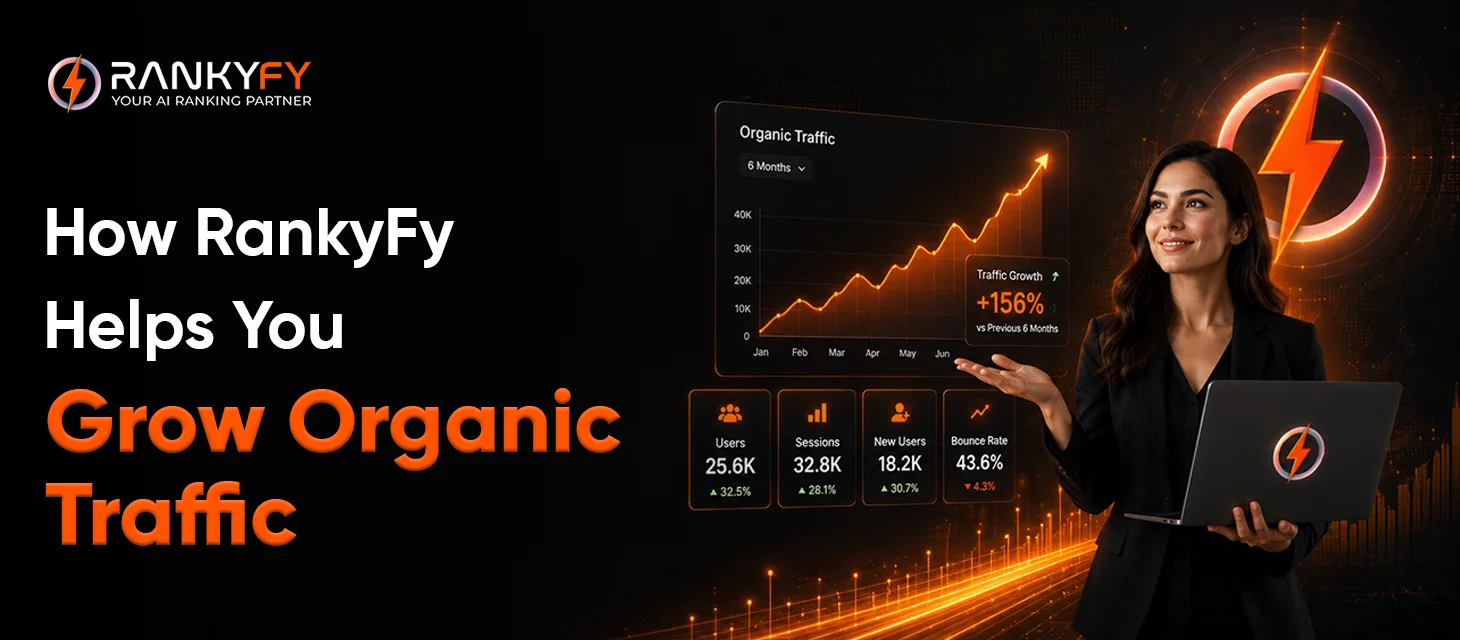
Organic growth strategies require much more than just blogs. It requires consistent effort in optimization, monitoring, and refinement of strategies. And RankyFy brings all these capabilities into one single platform.
With its site-wide audit, RankyFy can quickly detect any discrepancy that is holding your website back. The platform also offers actionable recommendations along with a priority list to streamline your actions.
Key capabilities include:
-
In-depth website audits
-
Scores for SEO, Content, etc
-
Heading structure analysis
-
Duplicate content detection
-
Internal backlink insights
-
Metadata analysis
-
Alt text optimization
-
Readability and keyword density metrics
-
Actionable optimization recommendations
How RankyFy Supports Organic Traffic Growth
| Organic Traffic Challenge | RankyFy Feature | Benefit |
|---|---|---|
| Technical SEO issues | Website Audit | Identifies crawl, indexing, and performance problems |
| Weak on-page optimization | On-Page Score | Improves page relevance |
| Thin or outdated content | Content Score | Strengthens content quality |
| Poor website structure | Heading Structure Analysis | Improves readability and SEO |
| Duplicate pages | Duplicate Content Detection | Prevents keyword cannibalization |
| Weak internal linking | Internal Backlink Analysis | Improves crawlability and authority |
| Poor metadata | SEO Analysis | Increases click-through rates |
| Image optimization issues | Image SEO Reports | Enhances accessibility and performance |
| Overall SEO performance | Site-Wide Content Metrics | Provides a complete website health overview |
Common Mistakes That Limit Organic Traffic
Here are some of the most common SEO mistakes that can limit your organic traffic growth:
-
Publishing content with no search intent
-
Duplicate or thin content
-
Targeting only high-volume keywords.
-
Ignoring technical SEO issues.
-
Neglecting internal linking.
-
Allowing older content to become outdated.
-
Neglecting SEO performance
Grow your organic traffic with RankyFy
Last Thoughts
Looking for organic growth strategies that deliver real results?
Choose RankyFy — an all-in-one SEO toolkit that uncovers actionable insights, identifies growth opportunities, and helps you improve your website’s organic performance.
Sign up today to analyze your website and get priority-based recommendations to grow your traffic smarter.
What to read next
What is a Domain? A Simple Guide to Domain Types & Examples
A domain is the unique web address people type into a browser to reach a...
Read More
What Is a Subdomain: Definition & Examples
A subdomain is an extension of a primary domain name that allows website owners to...
Read More
What Does a 404 Error Mean? Explained
A 404 error is a standard HTTP status code that appears when a web server...
Read More
Why is a robots.txt File Important?
A robots.txt file is a simple text file placed in a website's root directory that...
Read More