Table of content
- What Are AI Search Engine Citations?
- Why AI Citations Matter
- How Do AI Search Engines Choose Citations?
- Why Tracking AI Citations Is Difficult
- Steps to Track AI Search Engine Citations
- What Types of Content Get Cited Most Often?
- How to Improve AI Citation Visibility
- Common Mistakes When Tracking AI Citations
- Expert Tips for AI Citation Tracking
- How RankyFy Helps You Track and Improve AI Search Engine Citations
- Last Thoughts
Tracking AI search engine citations involves monitoring how often and in what context your brand, website, or content is linked by platforms like Google AI Overviews, ChatGPT, Perplexity, and Copilot.
This guide provides a direct framework for tracking your AI search engine citations, quantifying your AI share of voice, and identifying the specific data gaps that prevent your brand from being cited.
Get Real-Time AI Citation Tracking with RankyFy
What Are AI Search Engine Citations?
AI search engine citations are references or links that generative AI platforms (such as Perplexity, Google's AI Overviews, or ChatGPT) include within their responses to attribute the information they provide.
Unlike traditional search rankings, AI citations may appear as:
-
Source links
-
Brand mentions
-
Content references
-
Website citations
-
Suggested resources
-
Quoted information
Why AI Citations Matter
Today, AI search is evolving into a major source of information.
So, if your content is cited by AI search engines, you automatically earn:
-
More authority signals
-
Higher trust among users
-
Better brand visibility
-
Additional referral traffic opportunities
-
Greater influence in purchase decisions
How Do AI Search Engines Choose Citations?
AI search engines usually prioritize content that portrays:
-
Expertise
-
Topical authority
-
Accuracy
-
Semantic relevance
-
Clear structure
-
Strong user value
Why Tracking AI Citations Is Difficult
Unlike traditional SEO rankings, AI citations are dynamic.
The same question may generate different responses depending on:
-
User context
-
Search history
-
Query phrasing
-
Platform updates
-
Content freshness
Because of this, citation visibility can fluctuate frequently.
Businesses need dedicated tracking processes to monitor performance accurately.
Steps to Track AI Search Engine Citations
1. Monitor Brand Mentions Across AI Platforms
Start by searching for your brand on major AI search engines.
Ask:
-
What are the best SEO tools?
-
Which companies offer AI SEO solutions?
-
Best platforms for keyword clustering?
-
Top SEO software for agencies?
Document whether your brand appears in the answers.
Regular monitoring helps identify citation trends over time.
2. Track Citation Frequency
| Metric | Example |
|---|---|
| Query | Best SEO tools |
| Platform | ChatGPT |
| Brand Mentioned | Yes |
| Citation Included | Yes |
| Position in Response | Top section |
Tracking frequency helps measure visibility growth.
3. Monitor Competitor Citations
AI citation tracking should include competitor analysis.
Review:
-
Which competitors appear most often
-
What content gets cited
-
Which topics generate citations
-
Citation patterns across platforms
This reveals opportunities to improve your own content strategy.
4. Analyze Referral Traffic
Some AI platforms provide source links that users can click.
Monitor:
-
Referral traffic sources
-
Landing pages receiving AI traffic
-
User engagement metrics
-
Conversion behavior
Tools like analytics platforms can help identify AI-generated referrals.
5. Track High-Intent Questions
Focus on queries that influence purchasing decisions.
Examples:
-
Best CRM software for startups
-
Top SEO platforms
-
Email marketing tools comparison
-
AI SEO software reviews
These queries often generate citations that directly impact revenue opportunities.
What Types of Content Get Cited Most Often?
AI search engines tend to favor content that is:
- Comprehensive-
In-depth guides often perform better than thin articles.
- Structured -
Clear headings, lists, tables, and FAQs improve AI readability.
- Accurate -
Fact-based content builds trust.
- Topically Authoritative -
Websites covering subjects comprehensively tend to receive more citations.
- User-Focused -
Content that directly answers questions performs well.
How to Improve AI Citation Visibility
Create Answer-Focused Content
AI systems prefer content that clearly answers user questions.
Example:
What Is AI Citation Tracking?
Provide a concise answer immediately below the heading.
This format improves extractability.
Strengthen Topical Authority
Cover related topics comprehensively.
For example, an SEO website should cover:
-
Keyword research
-
AI SEO
-
Search intent
-
Content optimization
Authority increases citation likelihood.
Use Semantic SEO
Include relevant entities, concepts, and contextual terms naturally.
AI favors content that is contextually relevant instead of just exact keywords.
Conversational Queries Optimization
Users search in a natural conversational manner.
Examples:
-
How do I track AI search citations?
-
Why is my brand not appearing in AI answers?
-
What content gets cited by ChatGPT?
Targeting conversational searches improves citation opportunities.
Common Mistakes When Tracking AI Citations
Measuring Only Google Rankings
AI visibility requires separate tracking processes.
Ignoring Competitor Analysis
Competitor citation trends reveal valuable opportunities.
Tracking Too Few Queries
Citation visibility often varies significantly across topics.
Publishing Thin Content
Low-value content rarely earns consistent citations.
Neglecting Search Intent
Content must answer user questions thoroughly and accurately.
Expert Tips for AI Citation Tracking
Build a Query Library
Maintain a list of important questions relevant to your industry.
Track Multiple AI Platforms
Different systems may cite different sources.
Monitor Visibility Trends Monthly
Citation performance changes as AI models evolve.
Focus on Authority Topics
Strong expertise often leads to higher citation frequency.
Create Unique Insights
Original research and proprietary data increase citation potential.
How RankyFy Helps You Track and Improve AI Search Engine Citations
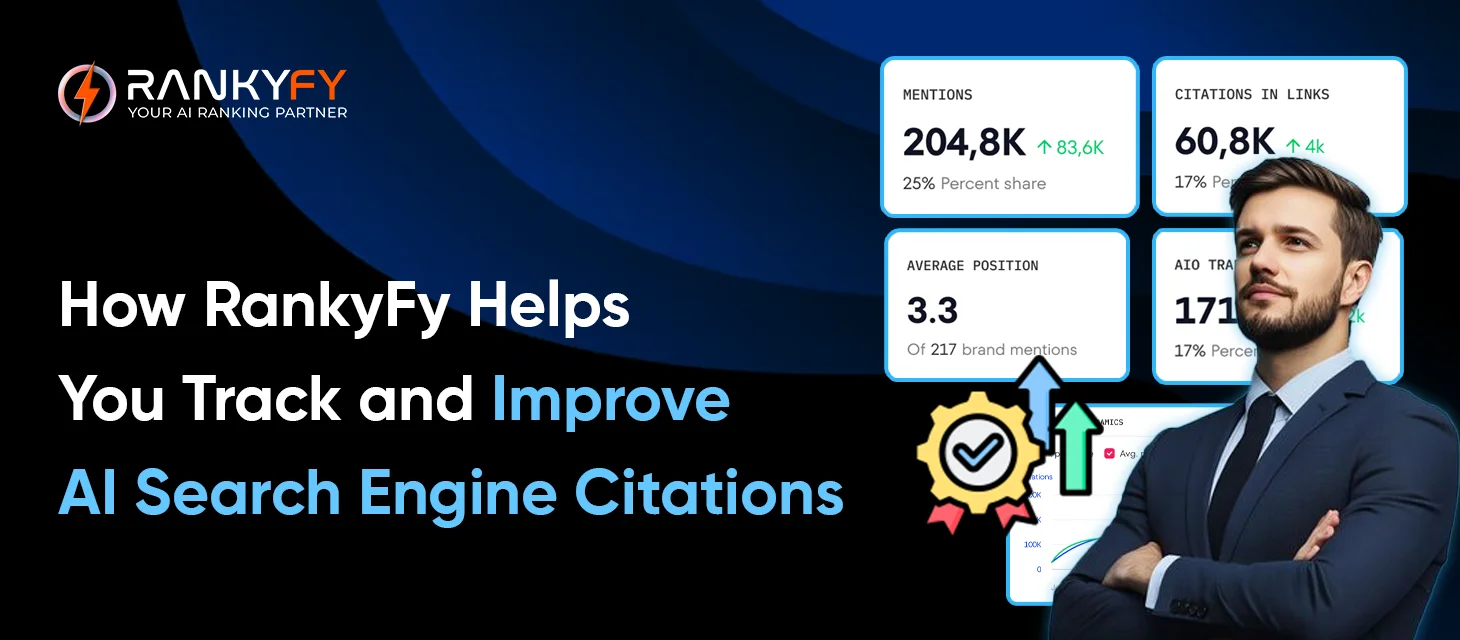
Today, AI visibility is among the most crucial parts of modern SEO. However, keeping a track of it manually is a challenge.
This is where RankyFy helps.
How RankyFy Supports AI Citation Tracking
- AI Search Visibility Monitoring
RankyFy helps you monitor your brand across AI-driven search engines.
- Citation Opportunity Analysis
Identify content most likely to earn AI references.
- Track Competitor Citations
RankyFy helps you discover which of your competitors are gaining visibility and why.
- Semantic SEO
With RankyFy, you can improve your contextual relevance and enhance citation potential.
- Search Intent Mapping
Align content with the questions users are asking AI systems.
- Topical Authority Development
Create content that strengthens your trust and citation frequency.
Get Real-Time AI Citation Tracking with RankyFy
Last Thoughts
Do you want to improve your chances of being cited across AI platforms? With RankyFy, your brand can stay visible, trusted, and competitive with the evolving generation of search. Try RankyFy today!
What to read next
How to Find and Fix SEO Errors on Your Website with the RankyFy Tool
RankyFy is an all-in-one SEO platform that helps you find your website's hidden technical flaws...
Read More
How to Fix Website Issues with an SEO Analyzer
Fixing website issues with an SEO analyzer involves scanning your site for technical, on-page, and...
Read More
How to Run a Complete On-Page SEO Audit in RankyFy: 5 Simple Steps
RankyFy simplifies On-Page SEO Audits by quickly identifying issues that affect your search rankings. A...
Read More
How to Audit Your Website Fast: A Step-by-Step Checklist by RankyFy
Audit your website with RankyFy’s practical, easy-to-follow checklist built for busy business owners, marketers, and...
Read More