Table of content
- What Are SEO Errors?
- Why Fixing SEO Errors Is Important
- Common SEO Errors That Hurt Your Website Rankings
- RankyFy – Your All-in-One SEO Platform
- Benefits of Using RankyFy for SEO Audits
- How to Find and Fix SEO Errors on Your Website with the RankyFy Tool
- How RankyFy Solves Common SEO Problems
- Best Practices for Maintaining a Healthy Website
- Common SEO Mistakes to Avoid
- Last Thoughts
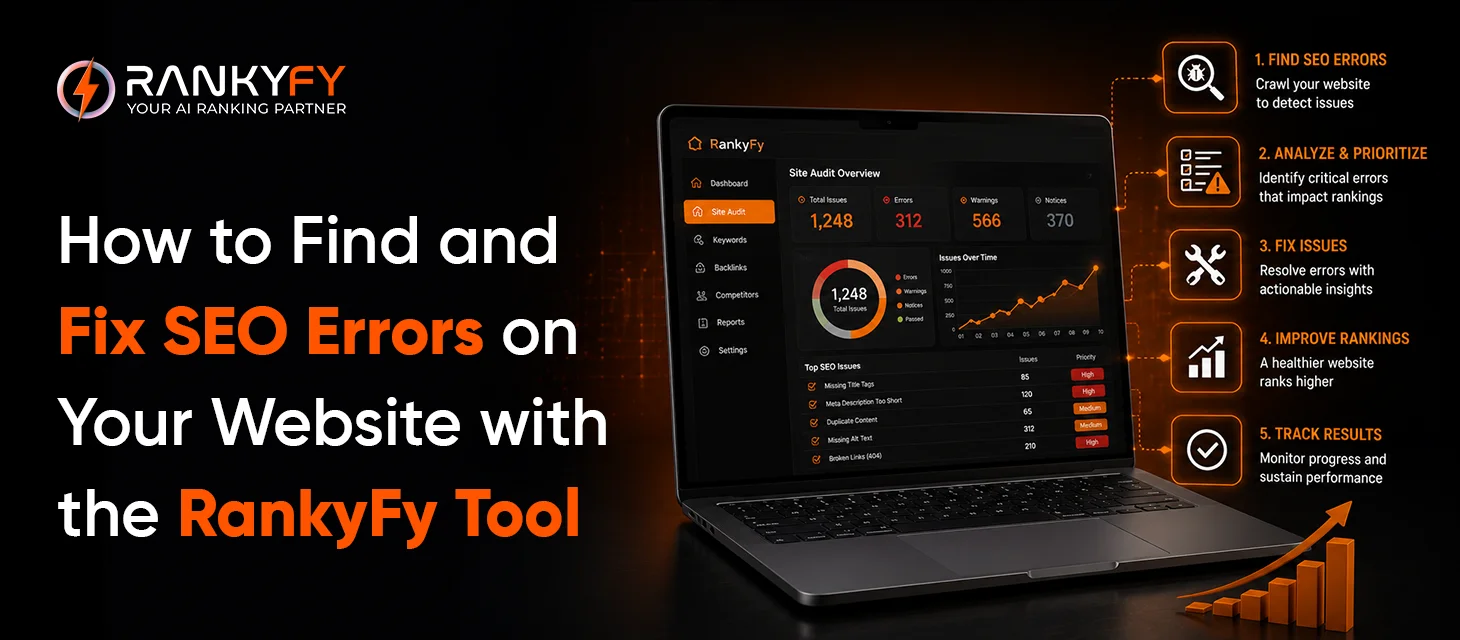
RankyFy is an all-in-one SEO platform that helps you find your website's hidden technical flaws so you can fix them before they impact Google rankings. Missing meta tags, broken links, and slow-loading pages constantly push your content down the search engine results pages without your knowledge. Manually hunting down these indexing and on-page bugs across hundreds of pages is nearly impossible. This guide will show you how to use RankyFy to run an automated site audit, prioritize critical errors, and quickly repair your website's health to boost organic traffic.
Identify and fix SEO errors faster with RankyFy. Start your website audit today.
What Are SEO Errors?
SEO errors are referred to as issues that prevent search engines from understanding your website. Some errors may affect crawlability and indexing, while others impact the user experience.
Common SEO errors include:
-
Missing title tags
-
Duplicate meta descriptions
-
Broken internal links
-
Crawl errors
-
Duplicate content
-
Missing image alt text
-
Slow page speed
-
Poor heading hierarchy
-
Thin content
-
Weak internal linking
SEO errors make it difficult for search engines to evaluate your website. This leads to lower search rankings and organic traffic.
Why Fixing SEO Errors Is Important
Search engines prefer websites that offer a fast and user-friendly experience. Therefore, ignoring SEO errors on your website will not only affect your rankings, but also user experience.
Fixing SEO errors can help you:
-
Improve search engine rankings
-
Increase website visibility
-
Enhance user experience
-
Strengthen website authority
-
Improve crawlability and indexing
-
Increase click-through rates
-
Build more organic traffic
With regular SEO audits, you can find and fix SEO errors on your website before they create significant problems.
Common SEO Errors That Hurt Your Website Rankings
Many SEO errors occur more frequently than others. It is critical to understand these problems and prioritize them to improve the overall website’s performance.
| SEO Error | How It Affects Your Website | Recommended Fix |
|---|---|---|
| Missing title tags | Reduces keyword relevance | Write unique, keyword-focused titles |
| Duplicate meta descriptions | Confuses search engines | Create unique descriptions for every page |
| Broken links | Poor user experience | Replace or redirect broken URLs |
| Thin content | Low topical authority | Expand content with valuable information |
| Duplicate content | Keyword cannibalization | Consolidate or rewrite similar pages |
| Missing image alt text | Missed accessibility and SEO opportunities | Add descriptive alt attributes |
| Poor heading structure | Makes content difficult to understand | Use proper H1, H2, and H3 hierarchy |
| Weak internal linking | Reduces crawl efficiency | Link relevant pages together |
| Slow-loading pages | Higher bounce rates | Compress images and improve performance |
| Crawl errors | Pages may not be indexed | Resolve indexing and crawl issues |
Fixing the above-given problems will improve the overall experience and search engine visibility for your website.
RankyFy – Your All-in-One SEO Platform

Finding and fixing every SEO issue manually can be an overwhelming task. RankyFy simplifies the entire task by consolidating all required tools into a single centralized dashboard.
So, instead of switching between multiple tools and complicated reports, RankyFy brings together all tools and organizes your website’s performance. This helps you focus on what matters most.
One of the biggest strengths of RankyFy is its intuitive dashboard. It analyses every page of your website to give dedicated performance scores:
-
SEO Score
-
Content Score
-
On-Page Score
-
Technical Score
These scores make it easy to identify which pages require immediate attention and which are already performing well.
Beyond page-level analysis, RankyFy provides a complete overview of your website's content health through Site-Wide Content Metrics. These metrics include:
-
Average Word Count
-
Readability Score
-
Keyword Density
-
Total Internal Links
-
External Links
-
Total Images
RankyFy also summarises your website’s content structure by displaying heading structures (H1, H2, H3 and H4).
Each page audit goes even deeper, highlighting important optimization opportunities such as:
-
Internal backlinks
-
Images without alt text
-
Title length
-
Meta description length
-
Duplicate content status
-
Page type
-
Heading hierarchy
So, instead of just identifying the SEO issues, RankyFy also explains what requires attention. Thus, making it easier for beginners and experienced marketers to prioritize actions.
Benefits of Using RankyFy for SEO Audits
Using a best SEO analyzer offers significant advantages over manual website reviews.
| RankyFy Feature | Benefit |
|---|---|
| Comprehensive Website Audit | Detects technical and on-page SEO issues quickly |
| SEO Score | Measures the overall optimization of each page |
| Content Score | Evaluates content quality and relevance |
| Technical Score | Identifies technical improvements |
| Heading Structure Analysis | Improves content organization |
| Duplicate Content Detection | Prevents keyword cannibalization |
| Internal Link Analysis | Strengthens website architecture |
| Image SEO Reports | Identifies missing alt text and optimization opportunities |
| Actionable Recommendations | Helps prioritize SEO fixes efficiently |
So, instead of spending long hours finding and checking pages one at a time, use RankyFy to centralize and get a clear roadmap to a healthy website.
Identify and fix SEO errors faster with RankyFy. Start your website audit today.
How to Find and Fix SEO Errors on Your Website with the RankyFy Tool
Step-by-Step: How to Find and Fix SEO Errors Using RankyFy
Once you have entered your website URL into RankyFy, the platform scans through your website pages.
Step 1: Run a Complete Website Audit
The first step is to enter your website URL to initiate a website audit tool. This may take a couple of minutes. Once the website scan is complete, you get a detailed SEO report on the dashboard.
Instead of digging through several spreadsheets or checking individual pages, RankyFy gives you a clear overview with prioritized recommendations.
Step 2: Review Site-Wide Content Metrics
Before analyzing individual pages, review the Site-Wide Content Metrics dashboard.
This section provides valuable insights into your overall content health, including:
-
Average Word Count
-
Readability Score
-
Keyword Density
-
Total Internal Links
-
External Links
-
Total Images
RankyFy offers valuable metrics that help you identify issues across your website.
Step 3: Analyze Individual Pages
The next step is to navigate to the Analyzed Pages section where you can review evey crawled URL.
Each page includes four dedicated performance scores:
-
SEO Score
-
Content Score
-
On-Page Score
-
Technical Score
With these scores, you can easily evaluate and compare pages to identify high priority areas.
RankyFy displays insights like:
-
Internal backlinks
-
Total images
-
Images without alt text
-
Heading structure
-
Title length
-
Meta description length
-
Duplicate content status
-
Page type
With this analysis, the SEO guesswork is replaced by confidence.
Step 4: Prioritize High-Impact SEO Fixes
Not every SEO issue impacts your search engine visibility. The smart approach is to start addressing problems that could have a greater impact.
Here are some high-priority SEO aspects:
-
Fix broken internal links
-
Optimize missing or duplicate title tags.
-
Rewrite weak meta descriptions.
-
Improve heading hierarchy.
-
Add alt text to images
-
Maintain internal linking
-
Expand thin content.
-
Resolve duplicate content.
Step 5: Monitor Progress Regularly
Since SEO is an ongoing process, it is critical to monitor the progress regularly.
With regular audits, your website can maintain its overall performance.
How RankyFy Solves Common SEO Problems
| SEO Problem | RankyFy Solution | Benefit |
|---|---|---|
| Missing title tags | Page-level SEO analysis | Improves keyword relevance |
| Duplicate meta descriptions | Metadata reporting | Helps create unique metadata |
| Broken internal links | Website audit | Improves crawlability |
| Thin content | Content Score | Strengthens topical authority |
| Weak heading structure | Heading analysis | Improves readability and SEO |
| Missing image alt text | Image optimization report | Enhances accessibility |
| Duplicate content | Duplicate content detection | Prevents keyword cannibalization |
| Poor internal linking | Internal backlink analysis | Improves site architecture |
| Technical SEO issues | Technical Score | Simplifies optimization priorities |
| Multiple SEO issues | Actionable recommendations | Creates a clear optimization roadmap |
Best Practices for Maintaining a Healthy Website
Follow these best practices to keep your website optimized:
Audit Your Website Monthly
Create a schedule for your website SEO audits.
Keep Content Updated
Ensure your content is accurate and updated.
Monitor Internal Links
As your website expands, ensure you review the internal links regularly.
Optimize Every New Page
Every new page should include:
-
A unique title tag
-
Optimized meta description
-
Proper heading structure
-
Relevant internal links
-
Descriptive image alt text
Track Improvements
Keep track of your audit reports to measure your progress and identify additional issues.
Common SEO Mistakes to Avoid
Many websites find it challenging to rank because they continue to make the same optimization mistakes.
Look out for these common SEO pitfalls:
-
Neglecting the technical health
-
Publishing duplicate or thin content
-
Keyword stuffing
-
Neglecting image optimization
-
Using multiple H1 tags incorrectly
-
Forgetting to update metadata
-
Creating orphan pages without internal links
-
Running SEO audits only once
Identify and fix SEO errors faster with RankyFy. Start your website audit today.
Last Thoughts
Struggling to find and fix SEO errors on your website?
Try RankyFy - your all-in-one SEO platform to find and fix every SEO error. The platform offers a complete toolkit to improve overall website performance. Sign up today!
What to read next

What Are the Best AI Search Visibility Monitoring Tools
AI Search Visibility Monitoring Tools like RankyFy track how often, how early, and in what...
Read More
How to Fix Website Issues with an SEO Analyzer
Fixing website issues with an SEO analyzer involves scanning your site for technical, on-page, and...
Read More
How to Run a Complete On-Page SEO Audit in RankyFy: 5 Simple Steps
RankyFy simplifies On-Page SEO Audits by quickly identifying issues that affect your search rankings. A...
Read More
How to Audit Your Website Fast: A Step-by-Step Checklist by RankyFy
Audit your website with RankyFy’s practical, easy-to-follow checklist built for busy business owners, marketers, and...
Read More