Table of content
RankyFy Tool helps analyze competitors’ backlinks and uncover the link-building tactics supporting their search visibility. Businesses can use RankyFy to identify valuable referring domains, anchor texts, and high-performing content to find realistic link opportunities and build a smarter, data-driven outreach plan.
Upgrade Your Backlink Strategy with RankyFy
Why Analyze Competitors' Backlinks?
There are many advantages when you analyze competitors' backlinks.
Some of them are as follows:
1. Identifying New Link Opportunities
It's most likely that your competitors already have links from domains that are relevant to your industry. These can offer high outreach targets.
2. Understand Competitor Authority
Studying various backlink profiles helps you understand how your competitors built their online presence.
3. Discover Content That Attracts Links
Understanding guides, reports, or blogs your competitor frequently links to can reveal topics. These are high-value content ideas you can cover more comprehensively.
4. Identify Link Gaps
Discover backlink gaps in your competitors' websites. These gaps are high opportunities for your SEO strategy.
5. Enhanced Outreach
Don't send generic outreach emails to several websites. Prioritize publishers that already show interest in your niche.
How to Find Competitors' Backlinks With RankyFy
Step 1: Identify Your Main SEO Competitors
The first step is to identify your competitors. Start with the sites that target your keywords.
It is important to note that your competitors don't necessarily have to sell the same products or services. Any website is an SEO competitor if it ranks for the same user search intent as you.
Create a list of 3 to 5 such competitor websites.
Evaluate your competitors on:
-
Target keywords
-
Industry relevance
-
Similar products or services
-
Target audience
-
Geographic market
Step 2: Analyze Competitor Domains
Enter a competitor's domain into the relevant RankyFy SEO analysis workflow and review the available domain and backlink insights.
The goal is to understand the competitor's overall authority and identify external websites contributing to its SEO presence.
Depending on the available report, review metrics such as:
-
Referring domains
-
Backlink sources
-
Linking pages
-
Anchor text
-
Follow and nofollow links
-
Link relevance
-
Competitor authority signals
Step 3: Identify High-Value Referring Domains
Once you have access to competitor backlink data, separate high- and low-value links referring to their domains.
Prioritize websites that are:
-
Relevant to your industry
-
Trusted by your target audience
-
Editorially credible
-
Receiving organic traffic
-
Likely to accept useful contributions or resources
Step 4: Look for Backlink Gaps
A backlink gap is one of the most useful insights from competitor analysis.
Suppose:
-
Competitor A has 80 relevant referring domains.
-
Competitor B has 65.
-
Your website has 30.
Don't simply try to acquire all 115 missing links. Instead, identify high-quality domains that link to multiple competitors but not to you.
These websites have already demonstrated an interest in your industry, making them particularly useful prospects.
Step 5: Examine Why Competitors Earned the Link
Finding a backlink is only the beginning. Investigate the reason behind it.
Ask:
Why did this website link to the competitor?
Possible reasons include:
-
Original research
-
Statistics
-
Industry guides
-
Expert commentary
-
Free tools
-
Case studies
-
Guest contributions
-
Resource pages
-
Digital PR campaigns
Understanding the reason helps you create a better strategy instead of simply asking for a link.
Step 6: Create a Better Linkable Asset
Now that you have identified the most result-yielding competitor content, build something that offers more value.
For example, if a competitor earned links to a basic industry statistics article, you could create:
-
Updated statistics
-
Original research
-
Expert quotes
-
Interactive charts
-
More comprehensive analysis
-
Downloadable resources
Step 7: Build a Prioritized Outreach List
Every backlink opportunity carries different priority weight.
Create a prospecting list based on:
-
Domain relevance
-
Website authority
-
Audience relevance
-
Link context
-
Outreach feasibility
-
Potential referral traffic
This makes your link-building campaign more efficient and reduces time spent contacting irrelevant websites.
Competitor Backlink Analysis: What to Look For
| Backlink Signal | What It Tells You | Opportunity |
|---|---|---|
| Referring Domain | Who links to competitors | Potential outreach targets |
| Linking Page | Where the link appears | Understand link context |
| Anchor Text | How competitors are described | Identify topic relevance |
| Content Type | What attracts links | Create stronger assets |
| Follow/Nofollow | Link attributes | Understand link profile |
| Domain Relevance | Industry connection | Prioritize relevant prospects |
| Multiple Competitors Linked | Shared industry interest | High-priority prospect |
How RankyFy Helps With Competitors' Backlinks Research
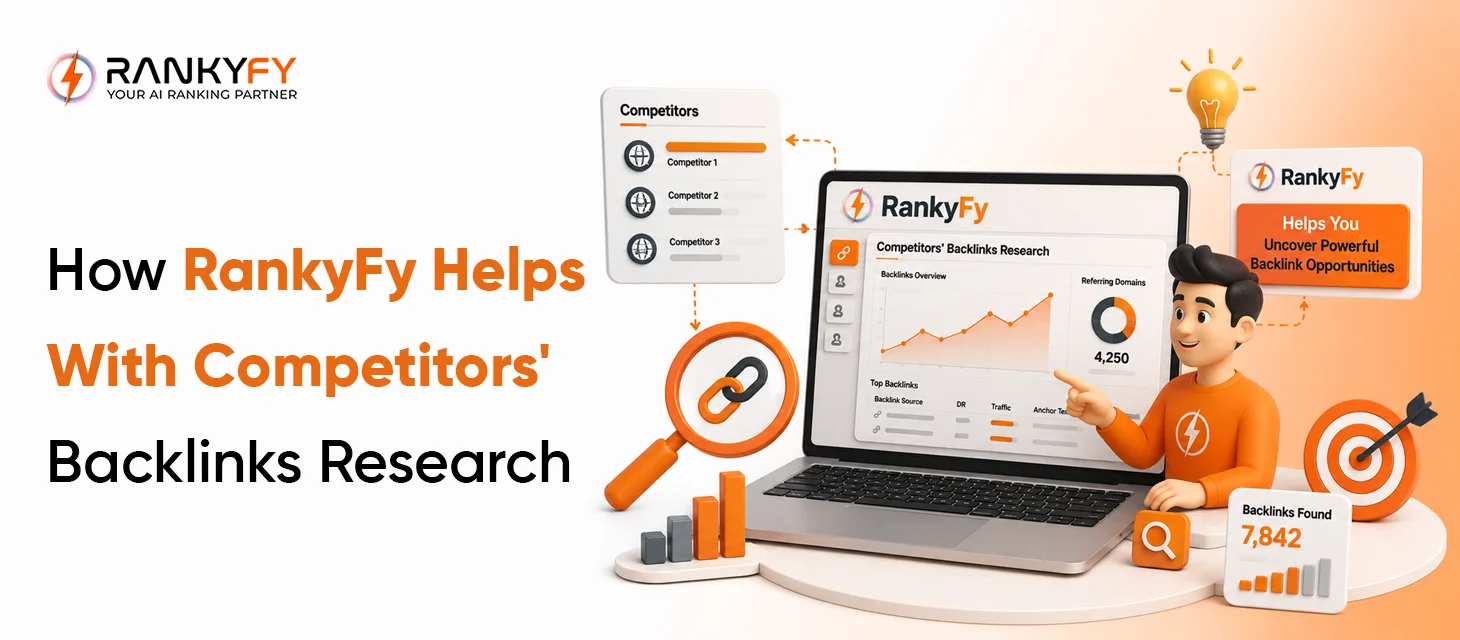
RankyFy can support a broader SEO workflow by bringing competitor research together with website auditing and optimization insights.
Instead of looking at backlinks in isolation, you can use RankyFy alongside your website's SEO analysis to analyze competitors' backlinks and understand where your site needs improvement.
For example, RankyFy's SEO analysis can help you evaluate:
-
Overall SEO performance
- Technical SEO health
- On-page optimization
- Content quality
- Internal linking
-
Page-level SEO scores
-
Website structure
RankyFy vs Manual Competitor Backlink Research
| Manual Research | RankyFy-Supported Workflow |
|---|---|
| Data collected across multiple sources | Centralized SEO analysis |
| Time-consuming comparisons | Faster identification of opportunities |
| Difficult to prioritize issues | Actionable SEO insights |
| Backlinks viewed in isolation | Backlinks considered alongside site health |
| Manual page analysis | Structured page-level SEO analysis |
Common Mistakes to Avoid in Competitors’ Backlinks
Copying Every Competitor Backlink
Not all backlinks are useful. Avoid using irrelevant and low-quality backlinks. These can hurt your rankings.
Emphasizing Only on Link Quantity
A high number of backlinks does not guarantee a strong backlink profile. It's important to identify authority, relevance, and context.
Ignoring Link Context
Before you decide if a link opportunity is worth pursuing, understand where and why a competitor has linked to them.
Using Forceful Anchor Text
Avoid using bold anchor text with exact keywords. Keep link acquisition a natural process and contextually relevant.
Forgetting Your Own Website
Your competitors' research should be an addition to your SEO strategy. Ensure the other aspects of your website are sound. Also make sure your content offers genuine meaning.
Upgrade Your Backlink Strategy with RankyFy
The Last Thoughts
Use RankyFy to turn competitor research into actionable SEO opportunities. Build a backlink strategy based on relevance and quality rather than link volume alone. Try RankyFy today!
What to read next

9 Reasons Why an SEO Audit Is Important For Your Site’s Success
An SEO audit is a systematic review of a website's technical health, on-page elements, content...
Read More
How to Scrape Data from Google Maps: A Complete Guide
How to scrape data from Google Maps is a common question among modern sales teams,...
Read More
How to Audit Backlinks with the RankyFy Tool
Audit Backlinks with the RankyFy Tool to protect your website from search engine penalties and...
Read More
How to Find Low-Competition Keywords With RankyFy Keyword Difficulty Checker
To find low-competition keywords using the RankyFy Keyword Difficulty Checker, you must filter for scores...
Read More