Table of content
- What Is SEO Gap Analysis?
- Why SEO Gap Analysis Matters in 2026
- How SEO Gap Analysis Finds New Traffic Opportunities
- Types of SEO Gaps You Should Analyze
- Step-by-Step Guide to SEO Gap Analysis
- Best SEO Gap Analysis Tools
- Common SEO Gap Analysis Mistakes
- Expert Tips for Faster SEO Growth
- How RankyFy Helps You Discover Hidden SEO Opportunities
- Last Thoughts
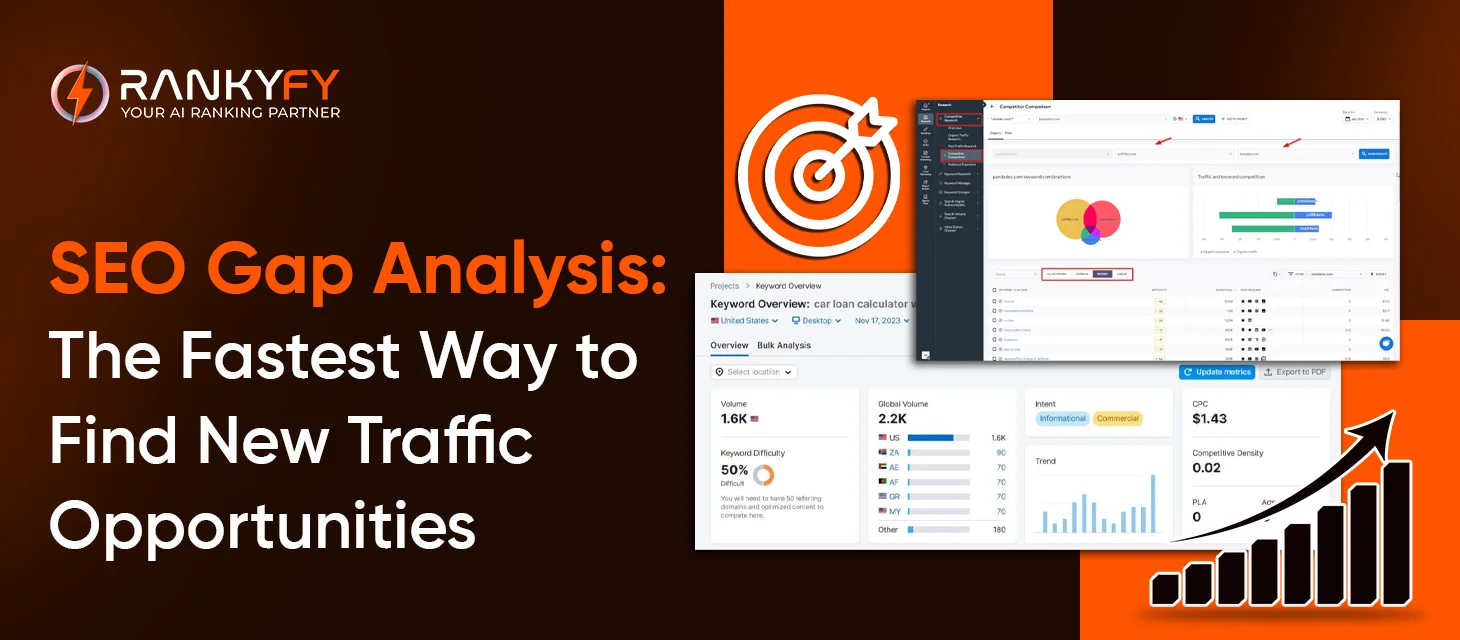
SEO Gap Analysis is the fastest, most predictable methodology for scaling organic revenue in the B2B sector. By auditing your current digital footprint against direct market alternatives, this data-driven process strips away search acquisition guesswork. It pinpoints the precise keywords, buyer intent stages, and technical content clusters your competitors dominate while your domain remains entirely absent.
In this guide, you'll learn what SEO gap analysis is, why it matters in 2026, and how to use it to uncover new traffic opportunities that can drive sustainable organic growth.
Grow Your Organic Traffic Faster with RankyFy
What Is SEO Gap Analysis?
SEO gap analysis refers to comparing your website’s search visibility against your competitors. This helps to identify any missed opportunities.
SEO gap analysis usually includes the following:
-
Keywords you don't rank for
-
Topics competitors cover, but you don't
-
Missing content clusters
-
Weak topical authority areas
-
Backlink opportunities
-
Search intent gaps
The primary goal is to identify opportunities where your competitors attract traffic.
Why SEO Gap Analysis Matters in 2026
In 2026, search engines have evolved keyword matching.
Today, every search system evaluates the following:
-
Topical authority
-
Semantic relevance
-
Search intent satisfaction
-
Content depth
-
User experience
So, many websites tend to lose organic traffic because they miss out on vital topic coverage.
SEO gap analysis assists businesses to:
-
Find quick-win keyword opportunities
-
Expand topical authority
-
Discover content ideas
-
Improve AI search visibility
-
Increase organic traffic
-
Maintain competitive positioning
How SEO Gap Analysis Finds New Traffic Opportunities
View your competitors as market research tools.
So, if your competitors rank for specific keywords that you don't, those rankings offer an already proven search behavior.
Gap analysis portrays:
-
What people are searching for
-
Which content performs well
-
Where your website is underrepresented
Hence, making SEO gap analysis one of the fastest ways to identify growth opportunities.
Types of SEO Gaps You Should Analyze
1. Keyword Gaps
Keywords gaps refer to those keywords that your competitors target and rank, but you don't.
Example
Competitor ranks for:
-
SEO audit checklist
-
AI SEO tools
-
Technical SEO guide
Your website does not.
These become immediate content opportunities.
2. Content Gaps
Content gaps happen when competitors cover topics that are completely missing from your website.
Example
Your website covers:
-
Keyword research
-
On-page SEO
Competitor also covers:
-
Semantic SEO
-
GEO optimization
-
AI search tracking
-
Topical authority
Expanding into these areas strengthens overall SEO visibility.
3. Topical Authority Gaps
Google increasingly rewards websites that demonstrate expertise across an entire subject area.
If competitors have deeper topic coverage, they may earn stronger authority signals.
Example
A competitor may have:
50 SEO-related articles
While you have:
10 SEO-related articles
The difference creates an authority gap.
4. Search Intent Gaps
Sometimes you target the same keyword but fail to satisfy user intent as effectively as competitors.
Questions to ask:
-
Are competitor articles more comprehensive?
-
Do they answer questions more clearly?
-
Are they optimized for AI search?
Intent gaps often reveal ranking opportunities.
5. Backlink Gaps
Backlink gaps are essential to identify websites that link to your competitors, but you don't. These gaps are potential authority and outreach opportunities.
Step-by-Step Guide to SEO Gap Analysis
Step 1: Identify Your Main Competitors
To target keywords, focus on your competitors
These may include:
-
Direct competitors
-
Industry blogs
-
Niche publications
-
SaaS platforms
-
Local businesses
Search competitors are often different from business competitors.
Step 2: Compare Keyword Profiles
Leverage top SEO tools like RankyFy to compare against your competitors.
Look for:
-
Keywords competitors rank for
-
Keywords where competitors rank higher
-
Untapped search terms
-
Emerging topic opportunities
Prioritize keywords with:
-
Relevant intent
-
Real traffic potential
-
Achievable competition levels
Step 3: Analyze Content Coverage
Review competitor content strategies.
Identify:
-
Missing topics
-
Weakly covered subjects
-
Outdated pages
-
Content opportunities
Look for patterns rather than isolated keywords.
Step 4: Evaluate Search Intent Alignment
Analyze whether competitor content satisfies search intent better.
Review:
-
Content format
-
Content depth
-
Structure
-
Readability
-
User experience
Sometimes, improving intent alignment produces faster results than creating new content.
Step 5: Emphasis on Opportunities
Not all SEO gaps need immediate attention.
Focus on:
-
Relevant keywords
-
Commercial intent topics
-
Low competition opportunities
-
Strong traffic potential
These usually generate the best ROI.
Best SEO Gap Analysis Tools
Several tools help automate gap analysis.
| Tool | Primary Use |
|---|---|
| RankyFy | AI-driven SEO opportunity discovery |
| Ranking Gap | Competitor research |
| The HOTH | Competitive visibility analysis |
| SEOptimer | Existing keyword insights |
| Keyword Insights | Topic clustering |
Common SEO Gap Analysis Mistakes
Focusing Only on Keywords
Modern SEO requires understanding topics, entities, and intent—not just keywords.
Copying Competitors Blindly
Gap analysis should inspire better content, not duplicate content.
Ignoring AI Search Trends
AI-powered search engines increasingly influence content visibility.
Trying Every Opportunity
Emphasizing only opportunities that align with your business goals yields outcomes.
Neglecting Topical Authority
Creating content that does not align with your website fails to yield success.
Expert Tips for Faster SEO Growth
Emphasis on Cluster Topics
Create content that is interconnected around major topics.
Target Long-Tail Opportunities First
These often provide faster ranking wins.
Use Semantic SEO
Cover related concepts, entities, and supporting topics naturally.
AI Optimisation
Structure and optimize your content for AI search platform visibility.
Update Existing Content
Refresh your existing content to get quick gains.
How RankyFy Helps You Discover Hidden SEO Opportunities

Executing SEO gap analysis manually can be an overwhelming and time-consuming task.
This is where RankyFy steps in to uncover growth opportunities faster.
How RankyFy Supports SEO Gap Analysis
- Discovering Competitor Gap
RankyFy identifies the best keywords and topics to rank your website that your competitors are missing.
- Semantic SEO Analysis
Uncover related topics and entities that strengthen content relevance.
- Search Intent Mapping
Understand what users actually want before creating content.
- AI SEO
RankyFy discovers the top opportunities to optimize your website for AI search platforms.
- Topical Authority Planning
The platform helps you build content that improves your visibility.
- Emphasis on Content Opportunity
RankyFy ensures your resources are used to the highest growth potential.
Grow Your Organic Traffic Faster with RankyFy
Last Thoughts
Are you looking for the right SEO tool that makes your SEO workflow easier and sustainable? RankyFy helps you discover the best opportunities for a faster, more strategic SEO workflow. Try RankyFy today!
What to read next

9 Reasons Why an SEO Audit Is Important For Your Site’s Success
An SEO audit is a systematic review of a website's technical health, on-page elements, content...
Read More
How to Scrape Data from Google Maps: A Complete Guide
How to scrape data from Google Maps is a common question among modern sales teams,...
Read More
How to Audit Backlinks with the RankyFy Tool
Audit Backlinks with the RankyFy Tool to protect your website from search engine penalties and...
Read More
How to Find Competitors’ Backlinks with the RankyFy Tool
RankyFy Tool helps analyze competitors’ backlinks and uncover the link-building tactics supporting their search visibility....
Read More