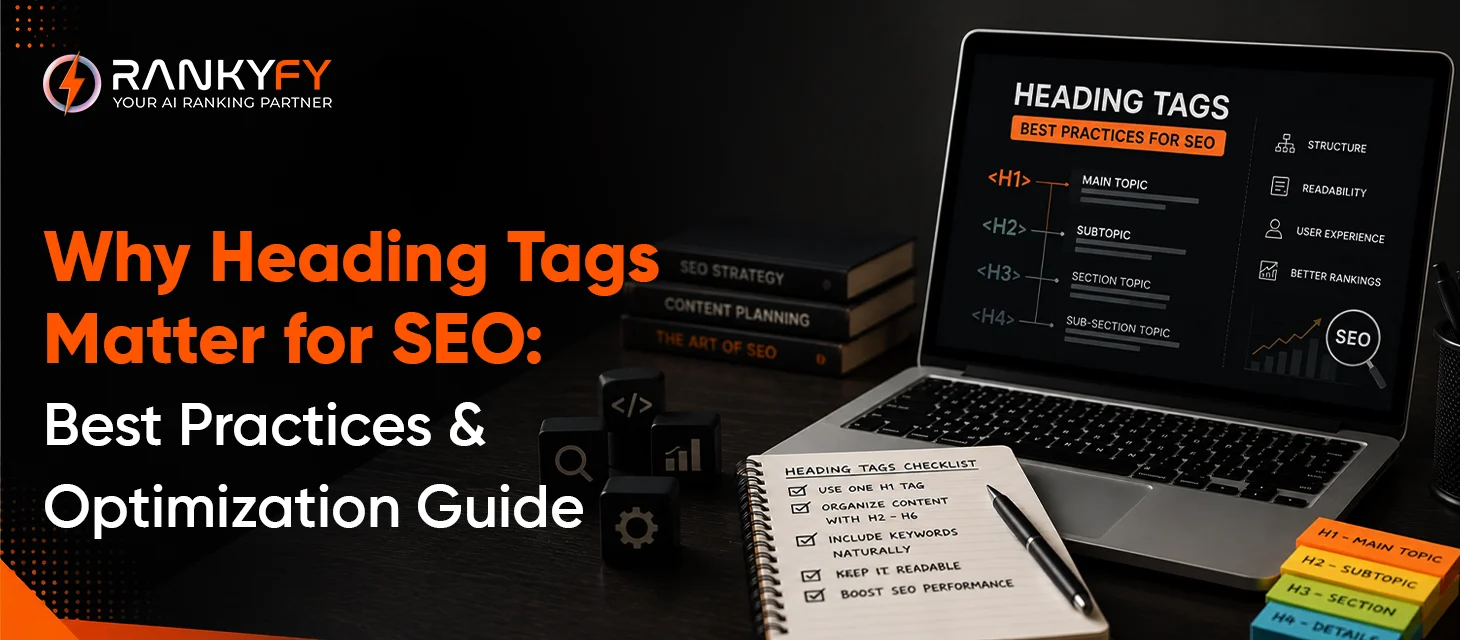
Heading tags form the architectural backbone of your website’s SEO and user experience. While search engines have evolved beyond simple keyword matching, headings (H1 through H6) remain critical anchors that help web crawlers decode the intent, structure, and contextual hierarchy of your content.
In this comprehensive optimization guide, you will learn why heading tags are essential for modern semantic search, how they drive user engagement, and the best practices required to structure your content for higher search rankings.
Optimize your headings using the RankyFY Heading Tag Tool.
What Are Heading Tags?
Heading Tags are referred to as HTML elements used to organize the webpage structure.
The typical range of heading tags is from H1 to H6. Each level portrays the importance of every section.
H1 – Main page title
H2 – Primary section headings
H3 – Subsections under an H2
H4- H6 – Supporting subheadings for more detailed content
Heading tags are like the outline of your content. They are esse ntial to guide both search engines and readers throughout the page.
Why Heading Tags Matter for SEO
Although heading tags are not one of the strongest Google ranking factors, they do improve how search engines interpret your content. Using an heading tag optimization tool can help ensure your primary heading is properly structured, includes relevant keywords, and clearly communicates the topic of your page to both users and search engines.
Better Content Structure
Search engines scan the headings of your content to understand its hierarchy.
Improved User Experience
Clear heading structure makes content navigation easier for visitors.
Keyword Relevance Support
Using your primary and relevant keyword naturally in the headings brings topical focus to your content.
Better Featured Snippet Opportunities
Featured snippets prefer well-structured headings followed by informative answers.
Better Accessibility
Screen readers rely on heading tags to help visually impaired users navigate web pages more efficiently.
Best Practices for Optimizing Heading Tags For SEO
Tag One H1 for Every Page
The H1 tag should clearly show the primary topic of the page.
It should:
-
Include the primary keyword naturally
-
Be descriptive
-
Match the page intent
-
Remain unique
-
Organize Content Logically
The H2 and H3 tags should be used for supporting information. Always use headings meaningfully to avoid any confusion.
Write Headings for Humans First
Use clear and informative headings. Natural language helps improve readability and user engagement.
Include Keywords Naturally
Use keywords naturally across your headings. Don't force them into every heading.
Use Descriptive Headings
Your reader should understand what each section holds by simply scanning the headings. Keeping headings clear also enhances your chance of getting featured in the AI-generated responses.
Optimize your headings using the RankyFY Heading Tag Tool.
Common Heading Tag Mistakes in SEO
With unstructured heading tags, even well-written content can lose its SEO value.
Here are some of the most common heading tag mistakes:
Multiple H1 Tags
Using multiple H1 tags in your content can dilute the primary focus.
Missing H1 Tags
Every important page should have one clearly defined H1.
Poor Heading Hierarchy
Using heading tags randomly (jumping from H1 to H4 directly) creates structural confusion, thus affecting SEO value.
Overuse of Keyword
Unnatural usage of keywords across multiple headings should be avoided.
Generic Headings
Avoid using generic headings like Introduction or Section 1. Instead, use specified headings that offer value.
Heading Tags and AI Search
With AI search engines in practice today, heading tags play an even greater role in content optimization.
AI systems often rely on headings to:
-
Understand page structure
-
Extract concise answers
-
Identify topic relationships
-
Generate summaries
With clear and descriptive headings, content is easier for AI platforms to cite and interpret.
This makes heading optimization extremely valuable.
How RankyFy Helps Optimize Heading Tags
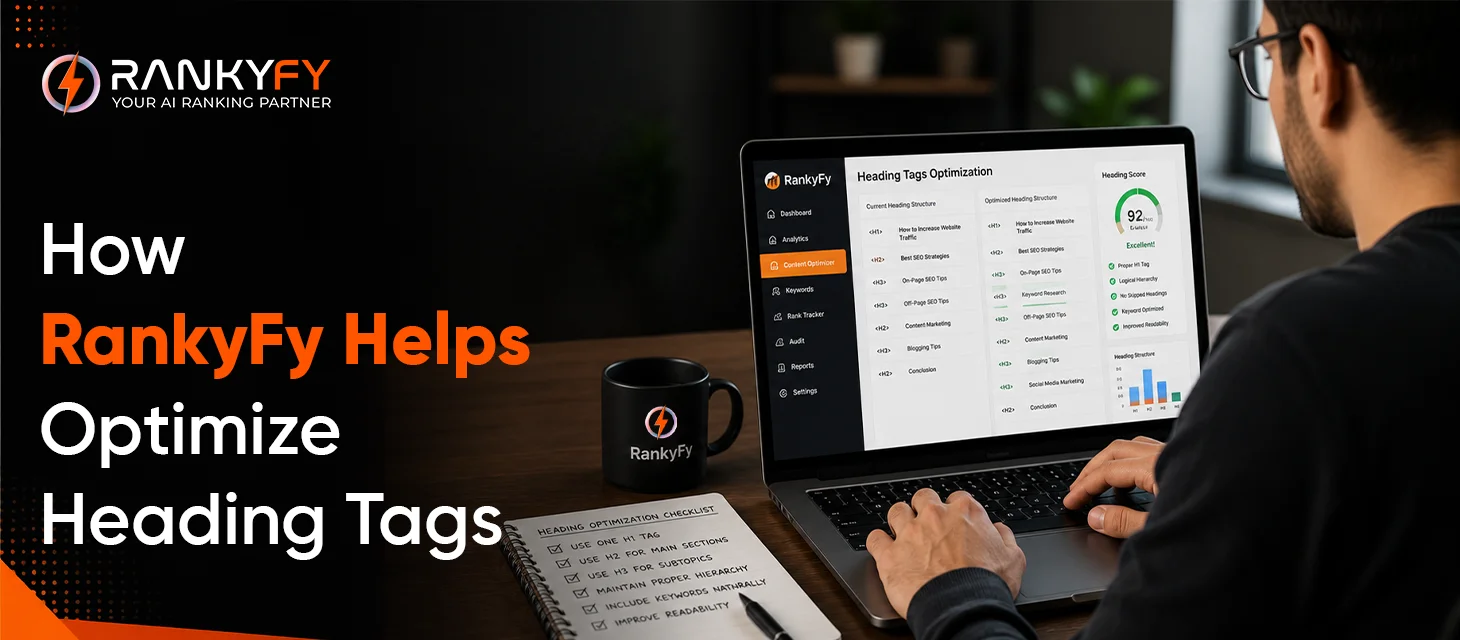
For effective on-page SEO, a strong heading structure is critical. However, reviewing every page manually is a challenging task.
RankyFy simplifies the process by automatically analyzing your website's heading hierarchy and highlighting areas for improvement.
Site-Wide Heading Structure Analysis
With RankyFy’s all-in-one dashboard, you get a comprehensive Heading Structure Summary. The platform provides the complete distribution of H1, H2, and H3 tags across your website. This makes it easier to identify heading tag discrepancies before they impact your SEO performance.
Page-Level Heading Insights
For each analyzed page, RankyFy evaluates:
-
H1 usage
-
Heading hierarchy
-
Missing headings
-
Structural organization
-
Overall on-page optimization
These insights help you quickly identify pages that require attention.
Improve Content Organization
With a consistent heading hierarchy, your content is easier for both users and search engines to understand.
Strengthen AI Search Readiness
Your content is most likely to get surfaced in Google AI Overviews if it’s well-organized. RankyFy helps ensure your pages follow best practices for structured content.
Summary Table of SEO Best Practices
| Best Practice | SEO Benefit |
|---|---|
| Use one H1 tag | Defines the page's primary topic |
| Organize headings logically | Improves content structure |
| Include keywords naturally | Reinforces topical relevance |
| Write descriptive headings | Enhances readability |
| Maintain proper hierarchy | Helps search engines understand content |
| Avoid keyword stuffing | Supports natural optimization |
| Audit heading structure regularly | Identifies on-page SEO issues quickly |
Optimize your headings using the RankyFY Heading Tag Tool.
Last Thoughts
Are you looking for the right optimization guidance for your website? RankyFy is a comprehensive SEO tool designed to support best SEO practices. Sign up on RankyFy today!
What to read next

9 Reasons Why an SEO Audit Is Important For Your Site’s Success
An SEO audit is a systematic review of a website's technical health, on-page elements, content...
Read More
How to Scrape Data from Google Maps: A Complete Guide
How to scrape data from Google Maps is a common question among modern sales teams,...
Read More
How to Audit Backlinks with the RankyFy Tool
Audit Backlinks with the RankyFy Tool to protect your website from search engine penalties and...
Read More
How to Find Competitors’ Backlinks with the RankyFy Tool
RankyFy Tool helps analyze competitors’ backlinks and uncover the link-building tactics supporting their search visibility....
Read More