
Table of content
- What Are Search Terms?
- Informational search terms
- Navigational search terms
- Commercial search terms
- Transactional search terms
- How Search Terms Work in SEO
- How to Use Search Terms Effectively
- In page titles and meta descriptions
- In headings and content structure
- In internal linking and anchor text
- Search Term Examples by Intent
- Common Mistakes When Using Search Terms
- Targeting overly broad terms
- How to Find the Right Search Terms with RankyFy
- Conclusion
Understanding search phrases is important to reach potential customers in a conversational tone. Search terms act as a bridge between customers and online businesses. For search engines, they are like windows or previews of the business and its services. For example, if you run an eCommerce shop, you will be targeting different customer segments with different products, and there will be several search terms, not just your brand name
To better understand and use search terms effectively, this post covers the fundamental types of search phrases, how they work in SEO, and how to use them without falling into common pitfalls.
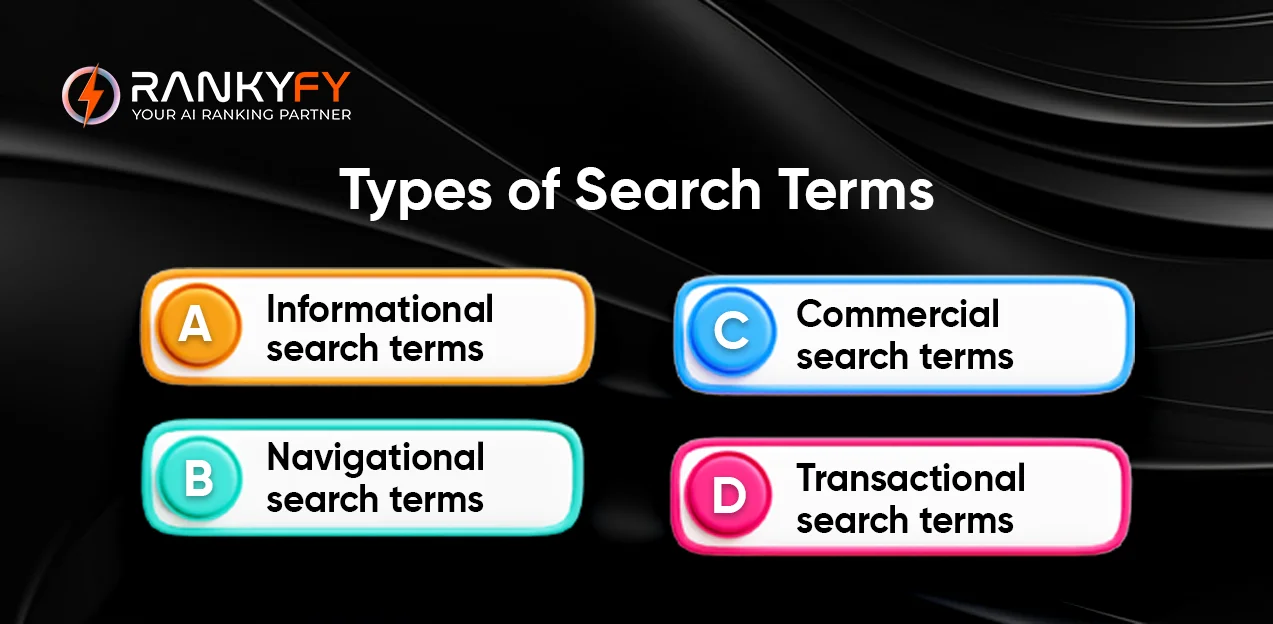 Here are the various types of search terms:
 By understanding the audience, search terms are a means to meet their preferences. A platform like RankyFy helps track keyword performance across traditional search engines and AI‑driven channels, showing which search terms drive impressions, clicks, and visibility.
By importing keyword ideas into RankyFy and monitoring their rankings on desktop and mobile over time, it becomes easier to see which terms gain traction and which need adjustment. The platform’s reports, location and language filters, and historical views can guide decisions about which informational, commercial, and transactional terms to prioritise, ensuring that effort goes into queries with real potential to drive results.
By understanding the audience, search terms are a means to meet their preferences. A platform like RankyFy helps track keyword performance across traditional search engines and AI‑driven channels, showing which search terms drive impressions, clicks, and visibility.
By importing keyword ideas into RankyFy and monitoring their rankings on desktop and mobile over time, it becomes easier to see which terms gain traction and which need adjustment. The platform’s reports, location and language filters, and historical views can guide decisions about which informational, commercial, and transactional terms to prioritise, ensuring that effort goes into queries with real potential to drive results.

What Are Search Terms?
The precise words or phrases people search for are called keywords. To appear in search results for such queries, website owners frequently map these keywords to produce content. When someone types a search query, their intent is revealed; they may be researching, searching for a certain website, considering their options, or getting ready to buy. What separates visitors who are genuinely likely to convert from random traffic is understanding the objective of a search phrase.Types of Search Terms
Here are the various types of search terms:
Informational search terms
As the name suggests, informational search terms are like definitions, guides, or manuals. Also, terms such as "how," "what," "why," and "guide" are included in this category. Individuals using informational terms are people starting with their reasearch but they are receptive to learning about new products and services. For this kind of purpose, content like blogs, tutorials, guides, and FAQs typically works well.Navigational search terms
Navigational search terms appear when users already know which website or brand they want but use a search engine to get there faster. Typical examples include “Facebook login,” “Gmail,” or “YouTube studio,” where the goal is simply to reach a specific page or platform. These searches show strong brand awareness rather than exploration. Optimizing for your own brand and main product names helps ensure users land on the right page and do not get lost with competitors or impersonators.Commercial search terms
Commercial search terms indicate that users are actively researching what to buy but have not chosen a specific product or provider yet. They often include phrases like “best,” “top,” “reviews,” or “vs,” such as “best SEO tools,” “email marketing software comparison,” or “iPhone vs Android for photography.” Searchers here are comparing options and are closer to a decision than purely informational queries. List posts, comparison pages, and review content work well to capture this traffic by answering detailed questions and showcasing benefits.Transactional search terms
Transactional search terms appear when users are ready to take action, usually to buy, subscribe, or sign up. These phrases frequently contain information to buy a product or service. Because these searches have the highest buying intent, these terms are an important part of the purchase cycle. Aligning these terms with clear calls to action can significantly improve conversions and revenue.How Search Terms Work in SEO
Search engines evaluate search queries to interpret user behaviour and expectations. While keyword optimisation remains important, understanding search intent has become the latest trend. Content relevance and contextual alignment now play a decisive role. Today’s SEO prioritises topical depth over exact keyword repetition. It focuses on addressing related concepts and phrases to convey the same intent. However, selecting the right search terms and positioning them still count to rank higher. The right search terms clearly interpret the purpose of each page.How to Use Search Terms Effectively
There are different ways to use search terms. Some of the effective uses are :In page titles and meta descriptions
Including a primary search term in the page title and meta description helps search engines and users quickly see what the page covers. Titles like “What Are Search Terms? Meaning and Examples” or “Best Running Shoes for Flat Feet” clearly signal relevance, while meta descriptions can reinforce the same phrase in natural language. The goal is to be clear and enticing rather than stuffing multiple variations into a single title. Well‑written titles and descriptions often improve click‑through rate, sending positive engagement signals back to search engines.In headings and content structure
Using your main search terms and closely related phrases in headings (H1, H2, H3) helps structure the page logically around user questions. For example, a guide on “email marketing tools” might use headings like “What Is Email Marketing Software?” and “Best Email Marketing Tools for Small Businesses,” reflecting both informational and commercial search terms. Breaking content into sections that mirror common questions and subtopics makes it easier for users to scan and for search engines to interpret the page. This alignment increases the chances of ranking for multiple related queries, not just one phrase.In internal linking and anchor text
Internal links help distribute authority across your site and show search engines how different pages relate to each other. Using descriptive anchor text that gently includes relevant search terms, such as “learn more about transactional keywords” instead of “click here,” improves context for both users and algorithms. Over-optimised or repetitive anchors can look spammy, so varying phrasing while staying descriptive is usually the best approach. A strong internal linking structure guides visitors to deeper, more specific content that matches their intent.Search Term Examples by Intent
Short‑tail vs long‑tail examples
Short‑tail search terms are broad phrases of one or two words like “shoes,” “insurance,” or “SEO tools,” which usually have high search volume but intense competition and vague intent. Long‑tail search terms are more specific multi‑word phrases, such as “best running shoes for flat feet” or “SEO tools for small businesses,” often with lower volume but clearer intent and higher conversion potential. A balanced strategy combines a few carefully chosen short‑tail terms with many targeted long‑tail queries. This mix can grow overall traffic while still capturing highly qualified visitors who know what they want.High‑intent vs low‑intent queries
High‑intent queries are those where users are close to taking an action, often appearing as commercial or transactional search terms like “best CRM software for startups” or “buy ergonomic office chair.” Low‑intent queries include broad or early‑stage informational searches such as “what is CRM” or “office chair types,” where the user is still learning and far from a purchase. Recognising intent helps determine what kind of page to create: educational content for low‑intent queries and product, comparison, or landing pages for high‑intent ones. Mapping intent to content type is one of the most effective ways to improve both rankings and conversions.Common Mistakes When Using Search Terms
Keyword stuffing
Keyword stuffing is the practice of overloading a page with the same search term or its variations in an attempt to manipulate rankings. This often leads to awkward, unnatural writing and can trigger search engine penalties or at least harm user experience. Instead, content should use search terms naturally and focus on answering the query comprehensively. A well‑written page that satisfies user intent usually performs better than a page that obsessively repeats a keyword.Ignoring intent
Targeting a search term without considering whether the content matches user intent is one of the fastest ways to attract the wrong audience. For example, ranking an in‑depth product review page for an early‑stage “what is” query can cause visitors to bounce quickly, signalling poor relevance. Aligning search terms with the right format—guides for informational, comparisons for commercial, and product or signup pages for transactional—creates a much smoother experience. This alignment improves engagement metrics and supports long‑term rankings.Targeting overly broad terms
Going after broad, highly competitive terms like “shoes” or “marketing” without authority, budget, or a strong brand usually leads to frustration and little traffic. These terms are dominated by large sites and often bring visitors with unclear goals even when they do rank. Focusing on more specific, niche, and long‑tail terms provides a clearer path for meaningful conversions. Over time, success with specific terms can help build the authority needed to compete for broader phrases.How to Find the Right Search Terms with RankyFy
By understanding the audience, search terms are a means to meet their preferences. A platform like RankyFy helps track keyword performance across traditional search engines and AI‑driven channels, showing which search terms drive impressions, clicks, and visibility.
By importing keyword ideas into RankyFy and monitoring their rankings on desktop and mobile over time, it becomes easier to see which terms gain traction and which need adjustment. The platform’s reports, location and language filters, and historical views can guide decisions about which informational, commercial, and transactional terms to prioritise, ensuring that effort goes into queries with real potential to drive results.
Conclusion
From initial research to final purchase, search terms are important for demonstrating online presence. Search terms enable interaction with people. If you know the distinctions between search terms and use them carefully, you will get more visibility. Search terms become a quantifiable strategy rather than guesswork when tools like RankyFy are incorporated to monitor performance and improve targeting, making every page work harder for visibility, traffic, and conversions. What to read next

13 Proven Ways To Use the Meta Ad Library for Research
Meta Ads Library is a free research tool for marketers. The platform is known for...
Read More
How to Migrate a Website Without Harming SEO (Complete Checklist)
How to Migrate a Website Without Harming SEO - Migrating a live website is a...
Read More
On-Page SEO Explained: A Complete Guide
What prevents your website from showing up at the top of search engine results? You...
Read More
How Local SEO Works: Everything You Need to Know
Local search engine optimization (local SEO) is one of the most important parts of increasing...
Read More