Table of content
- Why Is Your Website Not Ranking on Google?
- 11 SEO Fixes To Rank Your Website on Google
- Common SEO Problems That Hurt Rankings
- How RankyFy Helps You Identify and Fix Website Ranking Issues Faster
- How RankyFy Solves Common Ranking Problems
- What are the Best Practices to Improve Google Rankings?
- Last Thoughts
Why Is Your Website Not Ranking on Google? is a common question for site owners facing a drop in visibility or struggling to rank. If your business is missing from search results, you are losing valuable organic traffic, leads, and sales to competitors.
In most cases, your search visibility issues can be due to the following factors:
-
Google has not indexed your pages,
-
Target keywords are too competitive,
-
Content fails to match what users are searching for, or
-
Critical technical errors are holding you back.
This guide will help you identify the exact cause of your web ranking problem and provide 11 actionable, proven SEO fixes to get your website climbing the results pages.
Improve Google Rankings with RankyFy’s All-in-One SEO Tool.
Why Is Your Website Not Ranking on Google?
There could be many reasons why your website fails to rank on Google. And in many cases, a number of SEO issues work together to lower your website’s visibility.
What are the most common causes?
-
Technical SEO errors
-
Poor keyword targeting
-
Thin or outdated content
-
Weak internal linking
-
Slow-loading pages
-
Poor user experience
-
Crawl or indexing issues
The good news is:
each of these problems can be addressed with a structured SEO audit.
11 SEO Fixes To Rank Your Website on Google
SEO Fix #1: Target the Right Keywords
Many websites target either too competitive or completely unrelated keywords.
So, instead of focusing only on high-intent keywords, it's important to identify search terms that align with your product or services.
Here is a quick SEO fix tip
Target a mix of:
-
Primary keywords
- Long-tail keywords
-
Question-based keywords
-
Local search terms (if applicable)
SEO Fix #2: Improve Content Quality
Google prefers meaningful content that satisfies the user intent.
Thin pages with little value rarely perform well.
To improve your content:
-
Answer user questions clearly.
-
Include examples and practical advice.
-
Update outdated information.
-
Offer in-depth content
-
Enhance readability with structured headings.
Valuable content also improves user engagement and reduces bounce rates.
SEO Fix #3: Resolve Technical SEO Issues
Your website’s technical problems prevent search engines from indexing or crawling your pages correctly.
What are some common technical issues?
-
Broken links
-
Redirect chains
-
Crawl errors
-
Duplicate pages
-
Missing XML sitemaps
-
Wrong robots.txt settings
With regular technical audits, your website can identify and fix issues before they affect your rankings.
SEO Fix #4: Optimize Title Tags and Meta Descriptions
A well-optimized title tag is one of the strongest on-page SEO signals. Another important feature is well-written metadata.
Here’s what your pages should have:
-
A unique title
-
Relevant keywords
-
A compelling meta description
-
Right character length
SEO Fix #5: Strengthen Internal Linking
Internal links are important for search engines to understand page relationships. This also helps your visitors move through your website.
A strong internal linking strategy helps:
-
Improve crawlability
-
Distribute page authority
-
Increase time on site
-
Help important pages rank better
Improve Google Rankings with RankyFy’s All-in-One SEO Tool.
SEO Fix #6: Improve Page Speed
The speed of your website directly impacts your user experience and search rankings.
If your website has slow-loading pages, this might lead to high bounce rates and lower conversion rates.
Ways to improve page speed include:
-
Compress images.
-
Enable browser caching.
-
Minify CSS and JavaScript.
-
Remove unnecessary plugins
-
Use a trusted hosting provider
SEO Fix #7: Optimize Your Heading Structure
Optimized heading structure hierarchy helps both users and search engines to understand your content better. Each of your pages should have one descriptive H1 tag followed by well-organized H2 and H3 tags.
SEO Fix #8: Make Sure Your Website Is Mobile-Friendly
Google uses mobile-first indexing. This means it primarily evaluates the mobile version of your website when determining rankings.
A website with poor mobile performance may struggle to rank well.
To improve mobile usability:
-
Have a mobile-responsive website design
-
Ensure text is readable
-
Optimize your website images for smaller screens
-
Make the navigation simple
-
Avoid intrusive pop-ups
SEO Fix #9: Eliminate Duplicate Content
Search engines struggle to determine pages with duplicate content.
Here are some common causes:
-
Similar service pages
-
Product variations
-
Duplicate blog articles
-
URL parameter issues
-
Several versions of the same page
To avoid duplication, it's important to review your content regularly.
SEO Fix #10: Build High-Quality Backlinks
One of the strongest Google ranking factors is credible backlinks. This is because when authentic websites link to your content, it builds your website’s authority.
Focus on earning quality backlinks through the following:
-
Guest postings
-
Posting original research and content
-
Publishing valuable guides and resources
-
Building relationships with relevant industry publications
-
Producing content that naturally earns references
Remember, in backlinks, quality always outweighs quantity.
SEO Fix #11: Monitor Your Website with Regular SEO Audits
Since SEO is not a one-time plugin, websites require scheduled audits. These are important to help you identify underlying or new issues before they impact your rankings.
Here’s what a routine website audit can uncover:
-
Crawl errors
-
Broken links
-
Missing metadata
-
Duplicate content
-
Poor internal linking
-
Slow-loading pages
-
Technical SEO problems
Common SEO Problems That Hurt Rankings
| SEO Issue | Impact on Rankings | Recommended Fix |
|---|---|---|
| Poor keyword targeting | Low search relevance | Conduct keyword research |
| Thin content | Lower authority | Expand and update content |
| Broken links | Poor user experience | Repair or redirect links |
| Missing metadata | Lower CTR | Optimize titles and descriptions |
| Weak internal linking | Reduced crawlability | Add contextual internal links |
| Slow page speed | Higher bounce rates | Optimize website performance |
| Duplicate content | Keyword cannibalization | Rewrite or consolidate pages |
| Crawl errors | Pages may not be indexed | Fix indexing issues |
| Missing image alt text | Missed SEO opportunities | Add descriptive alt text |
| Poor heading structure | Difficult content hierarchy | Use proper H1, H2, and H3 tags |
How RankyFy Helps You Identify and Fix Website Ranking Issues Faster
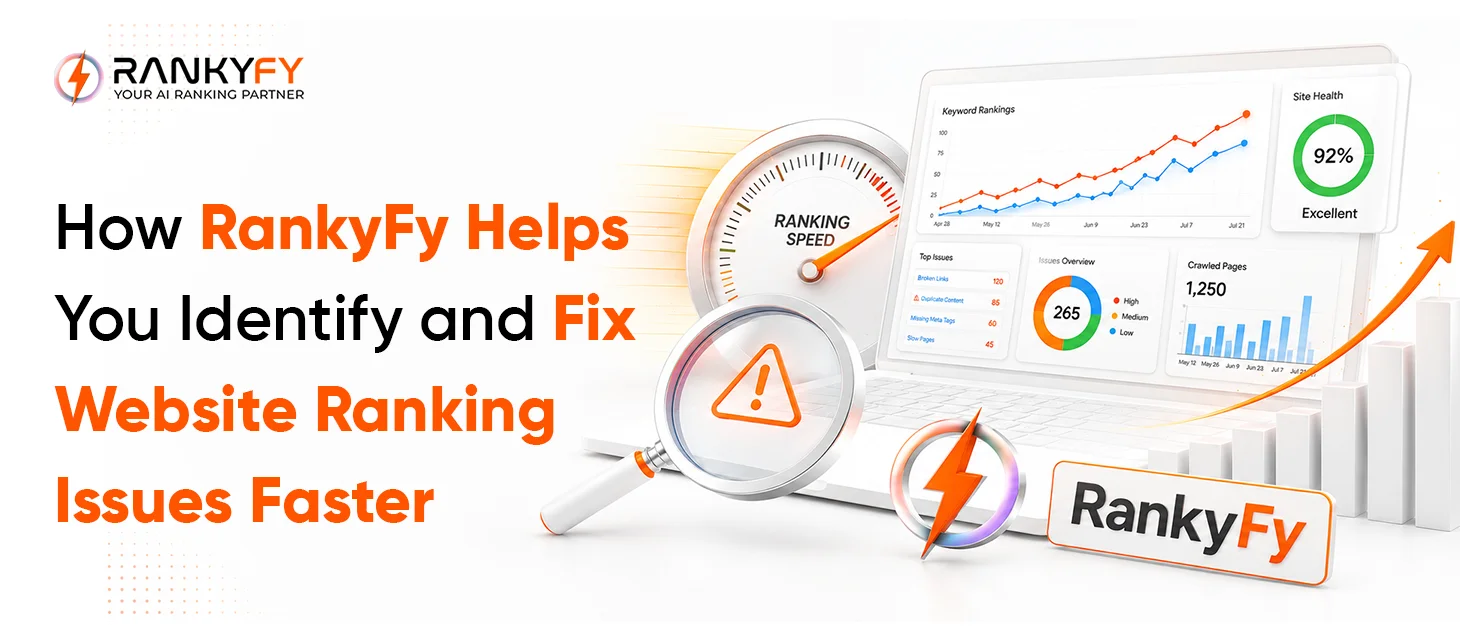
Manual efforts to find the root cause of why your website is not ranking on Google can be challenging. And RankyFy simplifies this process for you.
RankyFy is a complete SEO toolkit for marketers and entrepreneurs alike. The platform offers one centralized dashboard to find and fix everything that stops your website from ranking.
The platform also offers actionable insights and downloadable reports to understand what’s stopping you from ranking on Google.
RankyFy offers an in-depth analysis on:
-
SEO Score
-
Content Score
-
On-Page Score
-
Technical Score
-
Heading Structure
-
Title Length
-
Meta Description Length
-
Internal Backlinks
-
Duplicate Content
-
Images Without Alt Text
-
Site-Wide Readability
-
Keyword Density
How RankyFy Solves Common Ranking Problems
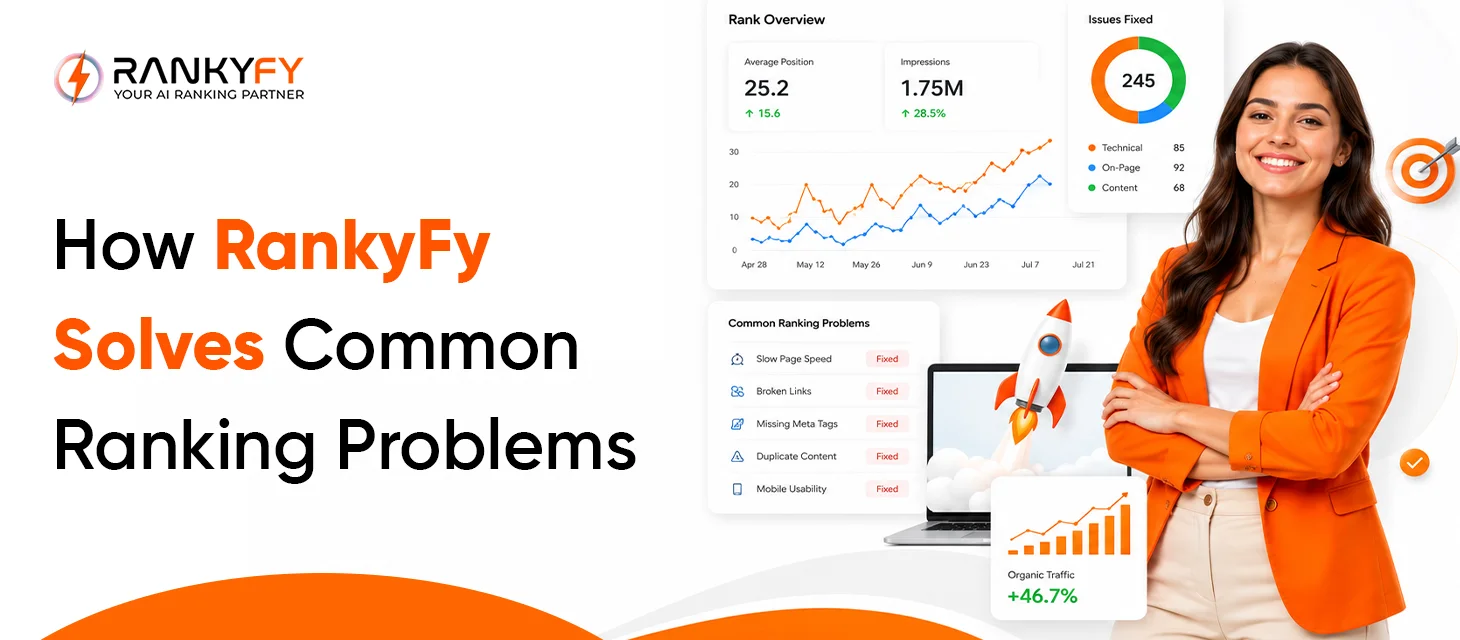
| SEO Challenge | RankyFy Feature | Benefit |
|---|---|---|
| Technical SEO issues | Website Audit | Identifies crawl and indexing problems |
| Weak on-page optimization | On-Page Score | Highlights optimization opportunities |
| Thin or poorly optimized content | Content Score | Improves content quality |
| Duplicate content | Duplicate Content Detection | Prevents keyword cannibalization |
| Poor heading hierarchy | Heading Structure Analysis | Improves readability and SEO |
| Missing metadata | Page-Level SEO Insights | Helps optimize titles and descriptions |
| Weak internal linking | Internal Link Analysis | Strengthens site architecture |
| Missing image alt text | Image SEO Report | Improves accessibility and image optimization |
| Overall website performance | SEO Score | Prioritizes high-impact improvements |
| AI search readiness | Structured content insights | Supports visibility in AI-powered search |
What are the Best Practices to Improve Google Rankings?
Here are some top best practice tips to improve your website’s Google rankings:
-
Regular SEO audits
-
Original, high-quality content
-
Page Optimisations
-
Enhanced Core Web Vitals
-
High Page loading speed
-
Build a logical internal linking structure.
-
Update outdated content regularly.
-
Keyword performance monitoring
-
Earning high-quality backlinks
-
AI and traditional search optimization
These are small but important improvements required to produce consistent results.
Improve Google Rankings with RankyFy’s All-in-One SEO Tool.
Last Thoughts
Can’t figure out why your website is not ranking on Google?
Run a comprehensive website audit on RankyFy. The platform offer in-depth audits and provide practical, actionable insights. Sign up today!
What to read next

9 Reasons Why an SEO Audit Is Important For Your Site’s Success
An SEO audit is a systematic review of a website's technical health, on-page elements, content...
Read More
How to Scrape Data from Google Maps: A Complete Guide
How to scrape data from Google Maps is a common question among modern sales teams,...
Read More
How to Audit Backlinks with the RankyFy Tool
Audit Backlinks with the RankyFy Tool to protect your website from search engine penalties and...
Read More
How to Find Competitors’ Backlinks with the RankyFy Tool
RankyFy Tool helps analyze competitors’ backlinks and uncover the link-building tactics supporting their search visibility....
Read More