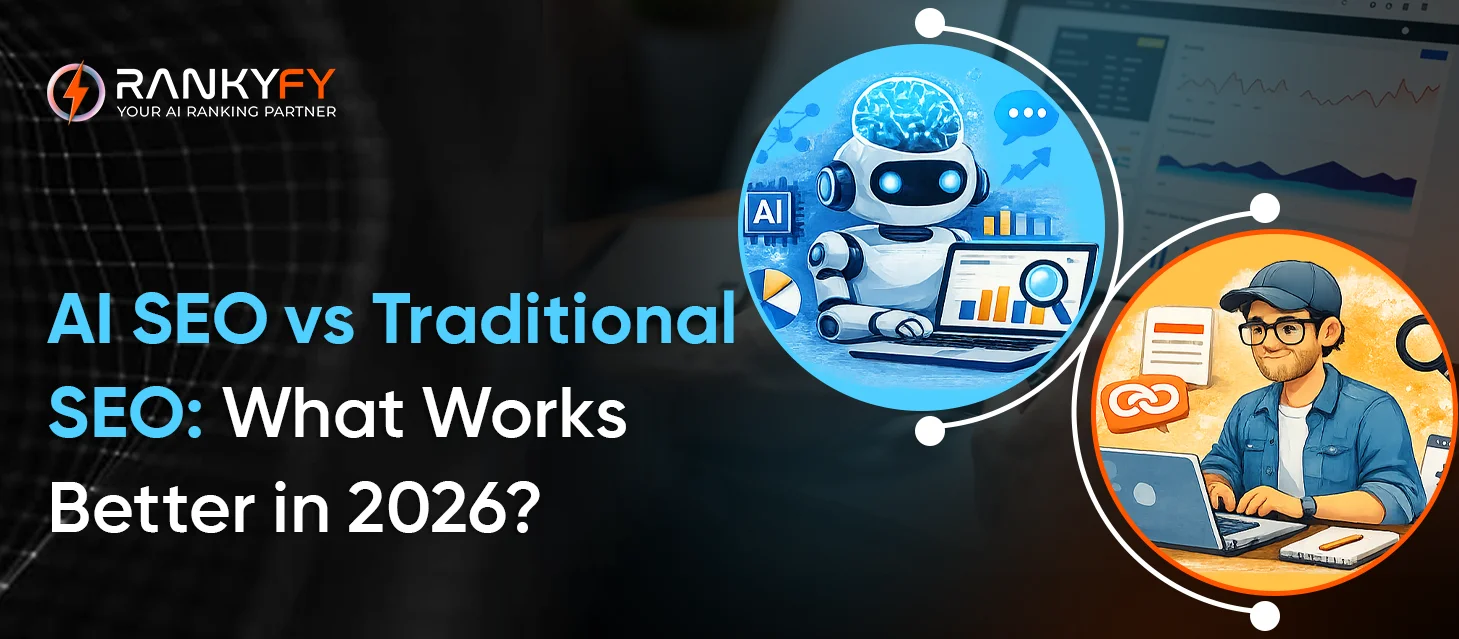
Over the past few years, SEO has evolved drastically. It has grown from just stuffing keywords into content to crafting strategies, but SEO is now smarter.
In 2026, artificial intelligence has also influenced the way SEO is approached. It is affecting website rankings, content quality, and more.
Due to this huge shift, many marketers and businesses have the same doubt- AI SEO vs Traditional SEO, what works better in 2026?
While many might take sides, the truth is, both have their own advantages. Traditional SEO is the foundation of strong visibility, while AI SEO brings automation into search intent.
Here, we walk through the difference between AI SEO and traditional SEO and help you conclude which one works better in 2026.
Get Better Control of Your SEO Audits with RankyFy Tool Today
Understanding Traditional SEO
Traditional SEO is the classic process of optimization techniques. This method has been used for years to improve overall web performance. Some of the traditional SEO processes include keyword research, creating search-friendly content, etc.
The core elements of Traditional SEO include:
-
Keyword research
-
On-page optimization
-
Link building
-
Technical SEO audits
-
Meta tags and internal linking
Traditional SEO is a manual and strategy-driven process. The outcomes of a traditional SEO process are heavily dependent on human expertise.
Understanding AI SEO
AI SEO leverages the power of artificial intelligence and machine learning in SEO. So, instead of managing everything manually, AI SEO uses AI tools to carry out the SEO tasks.
AI SEO helps in:
-
Finding semantic keywords
-
Understanding search intent
-
Generating content ideas
-
Automating technical audits
-
Predicting ranking opportunities
AI SEO vs Traditional SEO: Key Differences
1. Keyword Research
Traditional SEO
Traditional keyword research is the manual use of SEO tools to identify the high-performing keywords. These are usually analyzed on the basis of competition, volume, and difficulty.
AI SEO
AI SEO is a step further in this. They dive into the user intent, relevant topics, and semantic relationships. This is beneficial to help markets identify new opportunities.
So, which one is better?
AI SEI is a clear winner. This is because the search engines now focus on user search intent more than exact keywords.
2. Content Optimization
Traditional SEO
Content optimization with traditional SEO is just a manual process. It involves placing keywords into headings, descriptions, and content.
AI SEO
With AI tools, users are now analyzing the top-ranking pages and highlighting the gaps in real time. This helps writers optimize their content structures and keyword usage.
Who’s the Winner?
AI SEO. It offers efficiency and scalability.
3. Understanding Search Intent
Traditional SEO
It requires manual analysis of SERPs to retrieve what users want.
AI SEO
Through AI SEO, users can manage a massive amount of data and precisely identify the search intent of users.
Which one is more Beneficial?
AI SEO
4. Technical SEO
Traditional SEO
For maintaining the technical health, manual checks can be time-consuming.
AI SEO
AI SEO automates the regular monitoring of technical aspects such as broken links, crawlability, etc.
Who is the Winner Here:
AI SEO
5. Creativity and Human Connection
For creativity and human connectivity, traditional SEO has the edge.
Although AI can automate most of the SEO tasks, it often lacks when it comes to originality. Since the reader is a human, they tend to connect more with humane and authentic content.
AI cannot imitate the understanding of emotions, audience psychology, and storytelling. Therefore, it struggles to replicate fully.
Who’s the winner?
Traditional SEO with human creativity
The Rapid Rise of AI SEO
There are many reasons why businesses are adopting AI SEO in 2026:
-
Growing online competition
-
Need for time-efficient SEO workflows
-
Emphasis on user search intent
-
Smarter search engine algorithms
Why AI SEO Still Requires Human Expertise
Although AI SEO is a powerful approach, relying completely on AI automation can cause long-term problems.
A few common shortcomings of AI SEO are:
-
Generic or repetitive content
-
Lack of originality
-
Over-optimization
-
Lack of emotional intelligence
Hence, human sight matters. AI should be a supporting branch of SEO. It should not replace it completely.
AI or Traditional SEO: What Actually Wins in 2026?
To answer in a word -
none.
The best performing SEO strategies that work in 2026 require a balanced combination of both. AI is not a replacement; it best works as an assistant for your every SEO task.
Smart businesses and markets understand this and incorporate it into their SEO strategies. With the right AI insights and human expertise, you can see your SEO efforts become fruitful.
How RankyFy Bridges The Gap Between AI SEO and Traditional SEO
In 2026, SEO requires more than just AI automation. It needs a combination of strategy, content quality, and data. That’s exactly where RankyFy helps.
RankyFy gives you the best of both AI SEO and traditional SEO. The platform offers a set of AI SEO tools that help businesses improve their search rankings.
Here’s how RankyFy helps:
-
Smarter Keyword Research
RankyFy identifies semantic keywords and trending topics based on real search intent.
-
Content Optimization
RankyFy promotes readability and natural optimization. Instead of stuffing keywords, the platform offers structured keyword usage recommendations.
-
Easy-to-understand Technical SEO
It scans and identifies the technical issues instantly. This helps you fix those issues before they impact your visibility.
-
Competitor Analysis
With RankyFy, you can closely monitor your competitors and discover gaps to create better content.
-
Semantic SEO Support
RankyFy helps build topical authority by connecting related topics and improving content depth.
-
Scalable SEO Workflow
It helps manage your entire SEO workflow. Whether you handle blogs or large-scale content campaigns, RankyFy makes it easy.
Get Better Control of Your SEO Audits with RankyFy Tool Today
Last Thoughts
SEO in 2026 is an evolved version of what it was in past years. Today, the search engines have smarter algorithms, and users prefer search intent content. So, it is safe to state that competition is tougher than ever.
AI SEO offers automation and advanced guidance into search engine activity, while traditional SEO brings an authentic and human touch. By combining both, businesses have created the best SEO approach that yields the best results.
In the competition of AI SEO vs Traditional SEO: what works better in 2026, we have the answer. It is AI-supported SEO with a traditional approach to create smarter, more valuable content.
And with AI SEO tools like RankyFy, balancing both has become much easier. Try RankyFy today!
What to read next

HTTP vs HTTPS: SEO Impact Explained
Today, user security on a website is a necessity. Search engines and users prioritise websites...
Read More
ChatGPT Tracking Tools For SEO
AI-driven search experiences are evolving every day. Popular AI platforms like ChatGPT are shaping the...
Read More
Top Website SEO Mistakes That Kill Your Rankings
Ranking on Google requires strict SEO compliance. It also demands avoiding the wrong steps. Many...
Read More
Google Ranking Factors: The Complete 100+ List
Ranking on Google isn’t about a single tactic. It requires a strategic alignment of multiple...
Read More