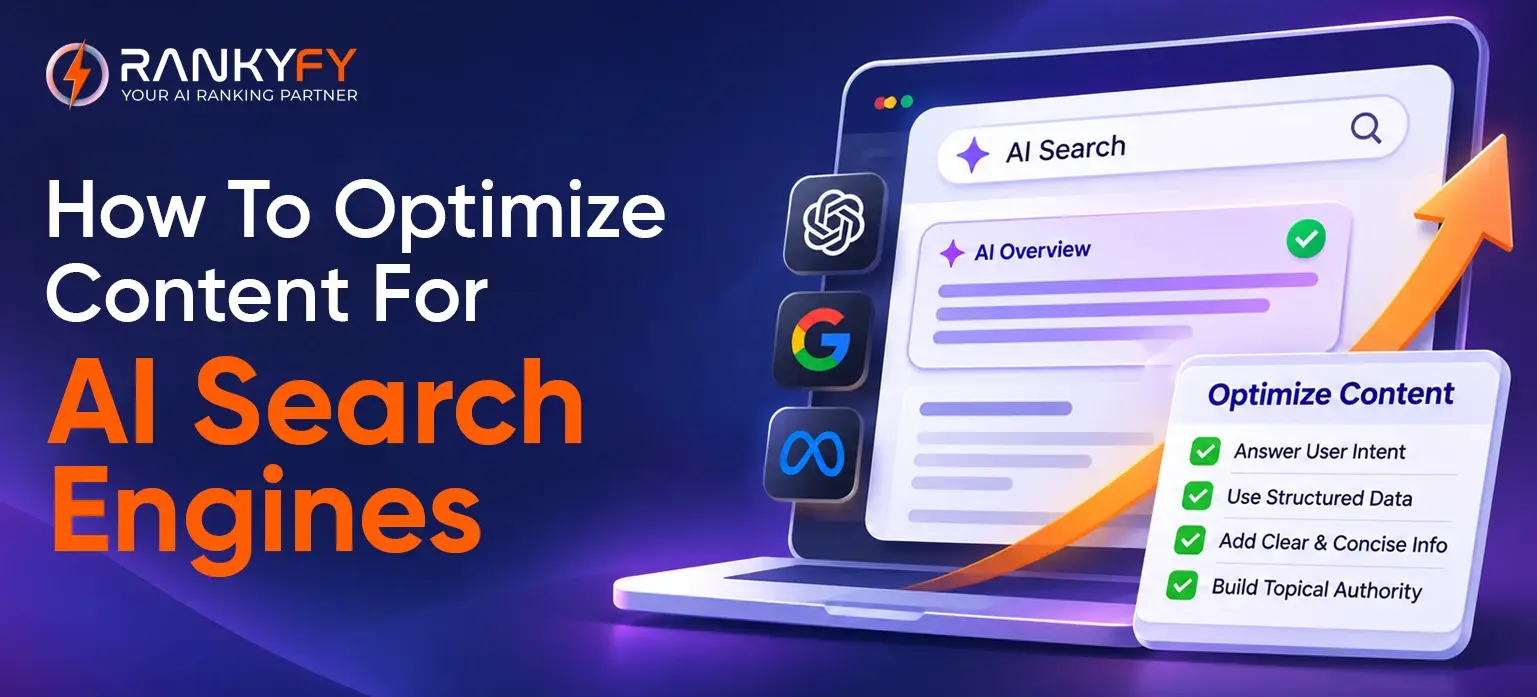
AI visibility plays an important role in helping brands reach a broader and more relevant audience. Optimizing content for AI search visibility requires targeted Generative Engine Optimization, or GEO, to help AI models easily scan, read, and understand the content and cite your website. To optimize content for AI search engines, focus on structuring pages around direct, conversational answers, building clear entity relationships, and strengthening EEAT signals.
Unlike traditional search engines that link to websites for answers, AI search engines extract direct content and present overviews in a single response. For businesses that want to rank in such answers, here is how to adapt your content strategy to win visibility in AI-driven search.
What is GEO?
GEO stands for Generative Engine Optimization. It is the practice of tailoring your content and brand signals so that AI search engines and chatbots such as ChatGPT, Google AI Overviews, Claude, and Perplexity quote, cite, and recommend your business.
For improved AI visibility, your content should clearly explain:
-
what you offer
-
who you help
-
why your information is worth mentioning
However, GEO does not replace traditional search engine optimization. While SEO helps search engines discover and rank your pages in SERP, GEO helps you get visibility in AI-generated responses.
Start optimizing your content today and Rank in AI citations
How AI Search Engines Extract Content
AI search engines extract content using a combination of traditional search indices, semantic chunking, and large language model (LLM) synthesis. The process works as follows:
- Crawling and Access
AI platforms use specialized bots to read your website content. They check your robots.txt and LLMs.txt files to confirm permission to pull your content for live user query answers.
- Query Fan-Out
AI search engines divide a user's question into parts. AI search engines search for information related to each part. It then searches traditional indexes (like Google) to answer every angle of the topic.
- Chunking and Vector Embeddings
AI engines do not read complete articles to find the answer. They slice the page into chunks. These can be single sentences, paragraphs, or tables that match the exact keyword of the query.
- Fact Extraction and Synthesis
The AI scans those chunks for verified facts. It prioritizes structured data, bullet lists, and small and direct sentences over dense paragraphs for citing the answers.
How to Optimize Your Content To Rank Higher In AI Search Engines
The rising question is now how to rank my website in AI search engines? To optimize content for AI search and Generative Engine Optimization (GEO), you need to shift your focus from chasing simple keywords to building clear, authoritative, and machine-parsable context.
-
Search Engine Optimization
Most AI search engines extract content from ranking webpages for the keyword. These websites already rank higher in the SERP using SEO.
To help your business rank higher, ensure open crawlability, fast page speeds, and clean HTTP status codes. SEO delivers the best results when the content is optimized with people-first intent.
-
Write for Conversational Intent
When a user is typing, they have a conversational intent. When looking for such answers, businesses should focus on direct answers in an easy-to-understand tone.
Many businesses optimize with a BLUF (Bottom Line Up Front) principle. It helps to optimize content to answer the core question in the opening section, avoiding any confusion.
-
Use AI-Friendly Formats and Structure
AI systems read sections independently and use language patterns to separate them into chunks. Even if bots pull them out of context, they still provide useful information. Keep it short – one idea per sentence to keep the format easy to understand and extract.
-
Build E-E-A-T Authority
AI tools rank unique and original data. To help make your data authentic, focus on original research and real-life case studies. Add brands, products, and people by referencing them to add authenticity to your content. Keep refreshing your old articles regularly as well. AI content gets refreshed in about one to three years.
Best Practices for Creating AI-Friendly Content
Here is how businesses can optimize content for better AI visibility.
| Category | Do | Don't |
| Structure |
Start each section with a clear answer. |
Use long introductions without useful information. |
| Headings |
Use simple headings based on real search queries. |
Use vague or misleading headings. |
| Formatting |
Use tables, lists, and bullet points for key details. |
Hide facts in long paragraphs or images. |
| Content |
Add original research, real examples, and expert knowledge. |
Publish repeated or copied information. |
Conclusion
AI search visibility starts with useful content, strong SEO, and clear answers. Focus on your audience, share real experience, and keep your website updated to improve your chances of appearing in AI search results. Use AI Search Ranking Tools to track and measure your brand’s visibility across AI search engines.
RankyFy offers a complete dashboard to help businesses manage SEO and GEO accurately from one platform. Try its AI-powered dashboard features to improve your content strategy and support your AI visibility.
Start optimizing your content today and Rank in AI citations
What to read next

What Are the Best AI Search Visibility Monitoring Tools
AI Search Visibility Monitoring Tools like RankyFy track how often, how early, and in what...
Read More
How to Find and Fix SEO Errors on Your Website with the RankyFy Tool
RankyFy is an all-in-one SEO platform that helps you find your website's hidden technical flaws...
Read More
How to Fix Website Issues with an SEO Analyzer
Fixing website issues with an SEO analyzer involves scanning your site for technical, on-page, and...
Read More
How to Run a Complete On-Page SEO Audit in RankyFy: 5 Simple Steps
RankyFy simplifies On-Page SEO Audits by quickly identifying issues that affect your search rankings. A...
Read More