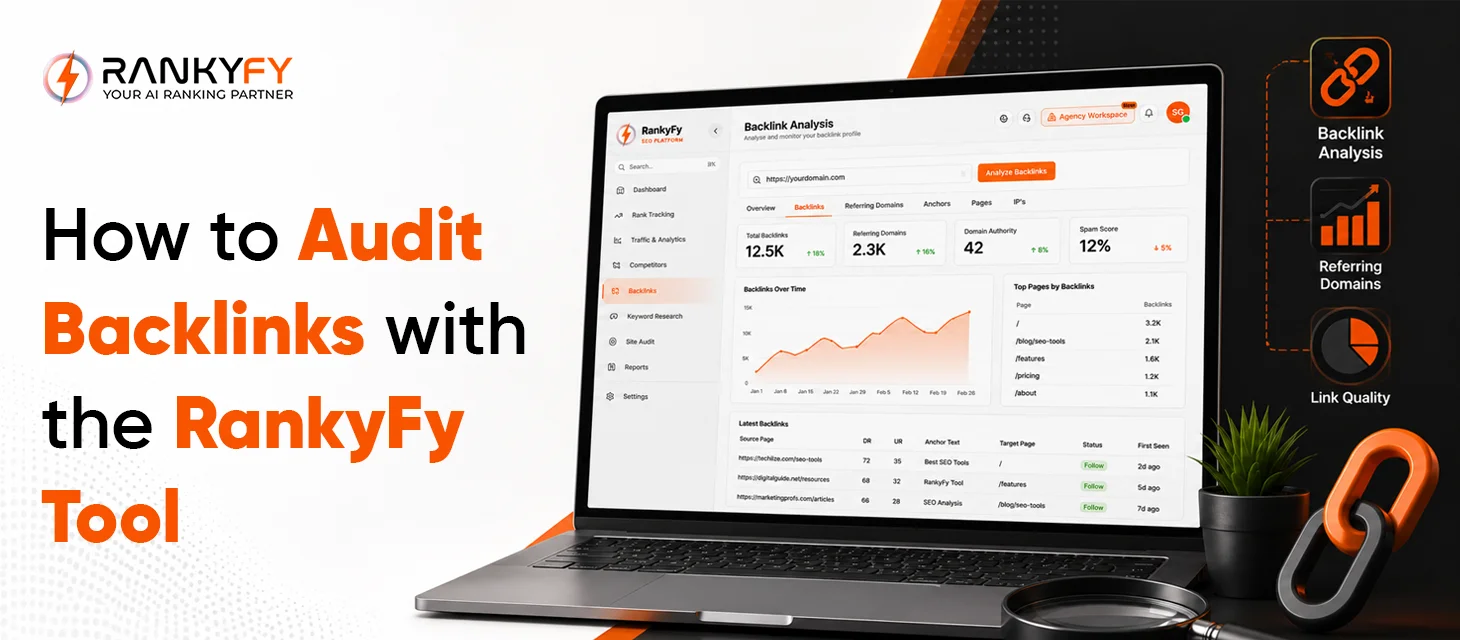
Get started with RankyFy's free backlink checker to audit your site's link profile, catch harmful links early, and strengthen your SEO strategy step by step.
Audit Backlinks with the RankyFy Tool to protect your website from search engine penalties and preserve your organic rankings. Over time, every website naturally accumulates spammy, toxic, or broken incoming links that can hamper its search visibility. Conducting a regular backlink audit ensures your link profile remains clean, healthy, and highly authoritative. In this comprehensive guide, you will learn exactly how to use the RankyFy platform to extract your backlink profile, flag toxic domains, clean up harmful link networks, and stay ahead of algorithmic updates.
Start Auditing Your Backlinks with RankyFy Tools
Why Should You Audit Backlinks?
Your backlink profile changes constantly. New websites may link to you, existing links can disappear, and some previously valuable links may become irrelevant.
Regular auditing helps you stay ahead of these changes.
1. Identify Valuable Backlinks
Not every backlink contributes equally. A relevant link from a trusted website can be considerably more useful than a large number of unrelated links.
2. Find Potentially Harmful Links
RankyFy provides a Toxicity Score to help identify backlinks that may require closer examination.
3. Monitor Lost Links
Any lost backlink from an authoritative website portrays a missed SEO opportunity.
4. Understand Your Link Profile
Understanding the anchor text, links, status, and referring domains offers a complete analysis of your off-page SEO.
5. Find Competitor Opportunities
Analyze competitors’ backlinks to uncover websites already linking to them. This can potentially uncover outreach opportunities.
How to Audit Backlinks with RankyFy
Step 1: Enter Your Domain
Start by opening RankyFy's Backlink Checker and entering your website domain.
RankyFy allows you to perform backlink analysis to identify links pointing to your website and examine important information about your backlink profile.
Once the analysis is available, begin with the overall backlink profile before diving into individual links.
Step 2: Review Your Total Backlinks
One of the first metrics to examine is the number of backlinks your website has. However, your backlink number is not the primary measure of SEO success.
Let’s understand this with an example:
Website A:
10,000 backlinks from 500 domains
Website B:
2,000 backlinks from 350 domains
Website B could potentially have a stronger profile if its referring domains are relevant and authoritative.
So, the total number of backlinks is a baseline of your backlink health.
Step 3: Analyze Referring Domains
Referring domains represent the unique websites linking to your website.
This is one of the most important backlink metrics to review because a diverse set of relevant referring domains can provide a stronger indication of your site's authority than repeatedly receiving links from the same domain.
RankyFy identifies referring domains and helps you examine the websites contributing to your backlink profile.
Look for:
-
Relevant industry websites
-
Authoritative publications
-
Trusted business websites
-
Niche-specific resources
-
High-quality editorial links
Also investigate domains that appear unrelated to your business or contain obvious spam signals.
Step 4: Check Domain and Page Trust
RankyFy provides Domain Trust (DT) and Page Trust (PT) scores. This helps evaluate the strength of domains and pages associated with backlinks.
These metrics can help you prioritize which backlinks deserve closer attention.
| Backlink Signal | What to Check |
|---|---|
| Domain Trust | Strength of the referring domain |
| Page Trust | Strength of the specific linking page |
| Relevance | Relationship between the linking website and your niche |
| Link Context | Why and where your website is being linked |
| Referring Domain | Whether the source is unique and valuable |
Don't evaluate a backlink based on a single metric. Relevance and editorial context should also be considered.
Step 5: Examine Individual Backlink Details
After reviewing your overall profile, move into individual backlink data.
RankyFy provides details such as the source page title, URL, anchor text, authority information, link attributes, and link status.
This lets you understand exactly how another website is linking to you.
For example, you may discover that an important product page has earned links from several industry publications. That page could become an asset worth promoting further.
Start Auditing Your Backlinks with RankyFy Tools
Step 6: Analyze Anchor Text
Anchor text is the clickable text used for a backlink.
Here’s what a healthy backlink profile contains:
-
Brand names
-
Website URLs
-
Natural phrases
-
Partial-match keywords
-
Relevant descriptive terms
Step 7: Check Dofollow and Nofollow Links
RankyFy can distinguish link attributes, including dofollow and nofollow links. This analysis offers an in-depth understanding of your backlink profile.
However, don’t assume that nofollow links are useless. These contribute to better referral traffic, brand exposure, and a natural-looking backlink profile.
The primary goal is to create a relevant and diverse link profile for your website.
Step 8: Find New and Lost Backlinks
Backlinks aren't static.
A website can gain new links while simultaneously losing valuable ones.
RankyFy tracks backlink status and provides information about new, active, and recently lost links.
Pay particular attention to lost links from high-value domains.
If an important backlink disappeared because a page was removed, a URL changed, or your link was replaced, investigate whether there is an opportunity to recover it.
Step 9: Identify Potentially Toxic Backlinks
Another useful part of a backlink audit is spotting suspicious or potentially harmful links.
With RankyFy, you get a Toxicity Score to flag backlinks.
Here are some potential warning signs:
-
Irrelevant websites
-
Obvious spam pages
-
Low-quality directories
-
Suspicious link networks
-
Unnatural anchor text
-
Large numbers of unrelated links
Step 10: Analyze Your Competitors' Backlinks
Backlink auditing shouldn't stop with your own website.
RankyFy also supports competitor backlink analysis, allowing you to investigate the links contributing to competing websites' SEO strategies.
Look for domains that:
-
Link to multiple competitors
-
Publish content in your industry
-
Maintain resource pages
-
Accept expert contributions
-
Reference industry research
-
Develop links to competitor guides or tools
Backlink Audit Checklist by RankyFy
| Audit Area | What to Check | Recommended Action |
|---|---|---|
| Total Backlinks | Overall link volume | Use as a baseline |
| Referring Domains | Unique linking websites | Prioritize relevant domains |
| Domain Trust | Referring-domain strength | Investigate high-value sources |
| Page Trust | Linking-page strength | Identify valuable individual links |
| Anchor Text | Link text distribution | Look for unnatural patterns |
| Link Attributes | Dofollow/nofollow | Maintain a natural mix |
| Link Status | New, active, lost | Recover valuable lost links |
| Toxicity | Potentially harmful links | Investigate suspicious sources |
| Top Linked Pages | Pages earning backlinks | Promote successful content |
| Competitor Links | Competitor referring domains | Find link-building gaps |
How to Turn a Backlink Audit Into an SEO Strategy
Your backlink audit is only as useful as the actions you take, which is why using reliable backlink audit tools like RankyFy makes it easier to turn findings into real improvements.
Safeguard Your Best Backlinks
Identify your strongest referring domains and maintain those relationships.
Recover Valuable Lost Links
Investigate important lost backlinks and contact the publisher when appropriate.
Build Link-Worthy Content
Highlight which pages actually attract the most backlinks. This helps you create more content around those topics and gain additional references.
Fill Competitor Link Gaps
Identify relevant websites that link to your competitors but not you. Then assess if you have a legitimate reason to earn a link from those websites.
Improve Link Diversity
Focus on earning links from different relevant domains rather than repeatedly acquiring links from the same sources.
Why RankyFy Is Useful for Backlink Auditing
RankyFy brings several backlink analysis functions into one workflow.
Its Backlink Checker provides comprehensive data on backlink counts, referring domains, source pages, anchor text, link status, and more.
It also connects backlink analysis with broader SEO auditing. RankyFy’s website audit examines internal and external links alongside content and other website issues, while its SEO Analyzer includes backlink analysis among its capabilities.
This approach is essential because backlinks don’t operate in isolation. A strong backlink profile performs best when backed by strong content, technical health, optimization, and linking.
Start Auditing Your Backlinks with RankyFy Tools
Last Thoughts
Ready to audit backlinks with the RankyFy tool?
Analyze your backlink profile, identify referring domains, review link quality, monitor changes, and uncover new opportunities for improving your off-page SEO. Try RankyFy today!
What to read next

9 Reasons Why an SEO Audit Is Important For Your Site’s Success
An SEO audit is a systematic review of a website's technical health, on-page elements, content...
Read More
How to Scrape Data from Google Maps: A Complete Guide
How to scrape data from Google Maps is a common question among modern sales teams,...
Read More
How to Find Competitors’ Backlinks with the RankyFy Tool
RankyFy Tool helps analyze competitors’ backlinks and uncover the link-building tactics supporting their search visibility....
Read More
How to Find Low-Competition Keywords With RankyFy Keyword Difficulty Checker
To find low-competition keywords using the RankyFy Keyword Difficulty Checker, you must filter for scores...
Read More